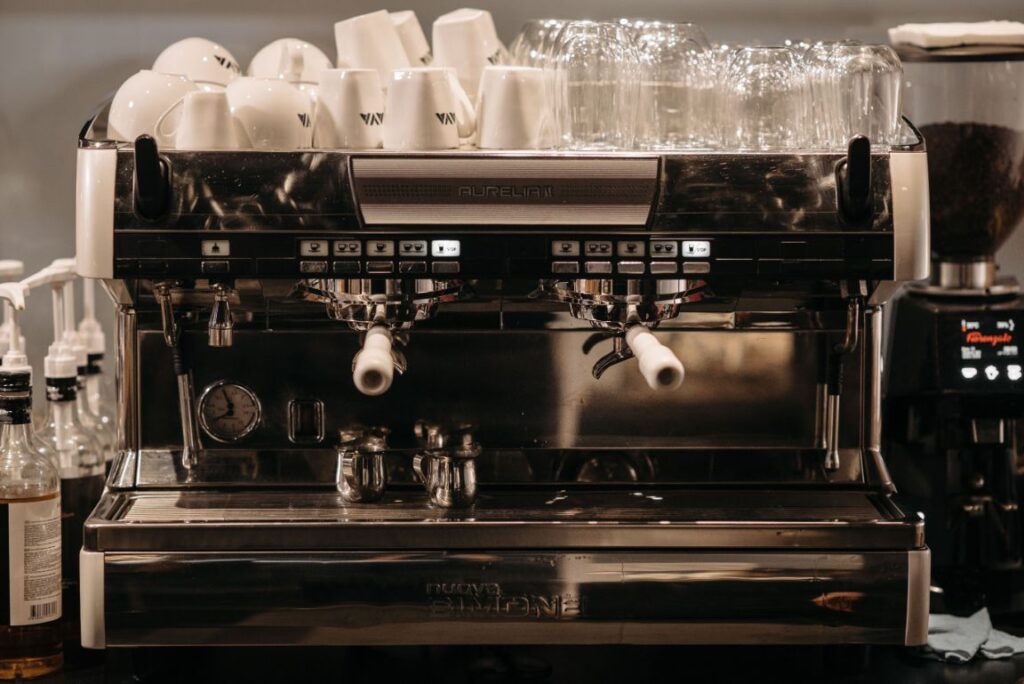
To descale an espresso machine safely, use the solution approved for your specific model, start the machine’s designated descaling program when it has one, and complete every rinse step before making coffee again.
Do not copy a random button sequence from another machine, even when it is made by the same brand.
Breville, De’Longhi, Philips, and Gaggia all use different procedures across their product lines. Some machines run an automated program, some require you to alternate between the group head and steam wand, and some higher-end machines should be descaled by a qualified technician rather than at home.
This guide explains the common process, what each step is trying to accomplish, and where you must stop and follow your machine’s manual instead.
Descaling checklist
| Item | What to use |
|---|---|
| Descaler | The product or chemical type approved by the manufacturer |
| Water | Fresh water in the amount stated by the descaler or machine instructions |
| Collection container | Large enough for the machine’s reservoir or specified rinse volume |
| Time | Set aside approximately 30 minutes, although some machines take longer |
| Water filter | Usually removed before descaling when the manual instructs you to |
| Expected result | Completed cycle, fully rinsed water path, normal flow and cleared warning light |
Philips, for example, instructs owners of many fully automatic models to remove the AquaClean filter, place a 1.5-liter container below the outlets, and allow roughly 30 minutes for the descaling and rinsing stages. Those measurements apply to the listed Philips machines, not automatically to every espresso maker.
What descaling actually removes
Water leaves mineral deposits inside an espresso machine as it is heated and circulated.
Those deposits are commonly called scale or limescale. They can collect inside heating components, pipes, valves, and other parts of the water circuit. Breville describes descaling as removing hard-water deposits from the machine’s internal system, while De’Longhi notes that the required frequency depends partly on local water hardness.
Descaling is not the same as removing coffee oils.
That distinction matters because espresso machines may require several separate maintenance routines:
| Maintenance task | What it addresses |
|---|---|
| Descaling | Mineral deposits from water |
| Backflushing or group cleaning | Coffee oils and residue in supported brew-group components |
| Steam-wand cleaning | Dried milk and blocked steam holes |
| Grinder cleaning | Coffee particles and oil in the grinder |
| Water-filter replacement | Water treatment before minerals enter the machine |
Philips explicitly states that its coffee-oil-remover tablets clean grease from the brew group but do not descale the machine. A cleaning tablet is therefore not a substitute for descaling solution.
How to know when your machine needs descaling
The most reliable signal is the machine’s descale warning or the schedule in its manual.
Possible signs of mineral buildup include:
- a descale or Calc/Clean warning
- slower water flow
- reduced drink volume
- coffee that is not as hot as expected
- increased brewing noise
- inconsistent hot-water or steam output
- a longer heating or brewing cycle
These symptoms are not proof that scale is the only problem. A blocked basket, dirty group head, clogged steam tip, failing pump, incorrect grind, or incomplete cleaning cycle can create similar behavior.
Philips states that regular descaling can help maintain drink temperature, volume, and brewing performance. De’Longhi also bases descaling intervals on water hardness and machine use rather than one schedule that fits every owner.
How often should you descale an espresso machine?
There is no safe universal schedule for every espresso machine.
Your actual interval depends on:
- the hardness of your water
- how frequently you use the machine
- how much water passes through it
- whether you make frequent Americanos or dispense hot water
- whether the machine uses an effective water filter
- the manufacturer’s maintenance program
- the internal design of the machine
Some manufacturers suggest an approximate interval for particular models. De’Longhi, for example, gives a broad three-month reference for some machines but also explains that frequency changes with water hardness and that many automatic models provide their own warning.
Treat the manual and machine indicator as the primary instructions. Do not postpone descaling simply because a generic online schedule says you have more time.
What descaling solution should you use?
Use the product named in your machine manual or a compatible descaler that meets the manufacturer’s requirements.
Different brands specify different formulations:
- De’Longhi says its descaling cycles are designed for lactic-acid descaler.
- Philips recommends its dedicated Philips/Saeco descaling solution for its fully automatic machines.
- Breville sells a machine descaler for its espresso range.
- Gaggia provides its own decalcifying solution and model-specific maintenance instructions.
Do not assume that all descaling products should be mixed at the same strength. A liquid bottle, concentrated dose, tablet, and powder may require different amounts of water.
Follow the measurement on the descaler packaging and the machine manual. When the two instructions appear to conflict, stop and check the manufacturer’s support material for your exact model.
Can you descale an espresso machine with vinegar?
Do not use vinegar unless your machine’s current manual explicitly permits it.
Vinegar may be recommended for certain basic coffee makers, but several espresso-machine manufacturers specify a dedicated descaling product or particular acid formulation. De’Longhi states that its descaling cycle is designed around lactic acid, while Philips directs owners to its approved descaler.
Vinegar can also leave a persistent smell or taste when the machine is not rinsed thoroughly.
The safest CoffeeInTown recommendation is simple: use the approved descaler rather than improvising inside an appliance with pumps, seals, valves, sensors, and heating components.
Before you begin: identify your machine type
The correct process depends on the machine.
Semi-automatic machine with a guided descale mode
Machines such as some Breville models use a particular button sequence or menu setting to enter descaling mode. The machine then controls part of the process but may ask you to move a container, turn a dial, or run solution through multiple outlets.
Semi-automatic machine without an automated program
Some pump machines require the owner to prepare the solution and manually dispense it through the brew outlet and steam or hot-water wand.
Gaggia’s general semi-automatic procedure, for example, uses containers beneath both the brew spout and steam wand so descaler can move through the relevant water paths.
Fully automatic or bean-to-cup machine
A fully automatic machine usually has an on-screen or button-guided Calc/Clean program.
Philips instructs owners of supported models to remove attached milk components and the AquaClean filter, add descaling solution to the reservoir, position a large bowl beneath the coffee and water outlets, and follow the automated cycle through descaling and rinsing.
Prosumer, heat-exchanger, or dual-boiler machine
Do not assume that a universal tank-descaling method is safe for an expensive prosumer machine.
Some models permit preventative descaling according to their manuals. Others warn that a calcified machine should be handled by an authorized technician because loosened scale may block internal tubing or because partial boiler disassembly may be necessary.
ECM’s Mechanika Max manual, for example, directs owners to a qualified service provider for descaling a calcified machine.
How to descale an espresso machine: the common process
These steps explain the usual workflow. Your machine’s manual determines the exact button sequence, solution quantity, outlet order, pauses, and rinse volume.
Step 1: Read the model-specific instructions
Find the model number on the machine’s label, base, service door, or original paperwork.
Then locate:
- the descaling section of the manual
- the approved solution
- the required amount of solution and water
- whether the machine must be hot or cool
- whether a water filter must be removed
- the minimum container capacity
- the correct descaling-mode sequence
Do not rely only on the brand name. Philips notes that even closely related Saeco models may require different procedures according to the model and serial number.
Step 2: Let the machine reach the required state
Your manual may tell you to turn the machine on, let it cool, empty its boiler, or place it in standby before entering descaling mode.
Do not remove parts while they are hot or while the machine is pressurized.
Empty the:
- drip tray
- used-coffee container on automatic machines
- portafilter
- water reservoir
Remove milk containers, frothing attachments, or water filters only when the manual instructs you to do so. Philips requires removal of the AquaClean filter and milk system on several machines before starting the cycle.
Step 3: Prepare the solution exactly as directed
Mix or pour the descaler according to its label and the machine instructions.
Do not:
- double the concentration for severe buildup
- combine different descaling chemicals
- add cleaning detergent
- place undissolved powder directly into the machine unless instructed
- guess the amount based on the reservoir size
A stronger mixture is not automatically more effective or safer.
When using a powdered descaler, dissolve it fully in the specified amount of water before it enters the reservoir unless the product directions say otherwise.
Step 4: Position a large collection container
Place a stable container beneath every outlet named in the instructions.
Depending on the machine, this may include:
- the group head
- coffee spouts
- hot-water outlet
- steam wand
- automatic milk-system outlet
Use a container large enough that you will not need to interrupt a programmed cycle unnecessarily. Philips specifies a 1.5-liter bowl for many of its automatic machines.
Place a towel nearby for splashes, but do not block vents or rest fabric against hot components.
Step 5: Start the designated descaling program
Use the correct menu option, dial position, or button combination.
Once the program begins, follow the machine’s prompts exactly.
A guided cycle may:
- dispense small amounts of solution
- pause so the solution can act
- alternate between outlets
- request more water
- ask you to empty the drip tray
- wait for confirmation before rinsing
Do not unplug the machine or allow it to enter standby unless the instructions specifically tell you to.
Interrupting the program is a common reason a descale warning remains active afterward. De’Longhi explains that a light staying on can mean the process was not correctly completed, while Philips states that some warning lights clear only after the full procedure is finished.
Step 6: Follow the outlet sequence for a manual cycle
When the machine has no automatic program, the manual may tell you to dispense portions of solution through different water paths.
A typical sequence may involve:
- Dispensing some solution through the group head.
- Stopping the pump.
- Allowing a short resting period.
- Dispensing solution through the steam or hot-water wand.
- Repeating until the reservoir reaches the stated level.
- Turning the machine off or pausing for a specified period.
Do not invent this sequence for your machine. It is included here only to explain why generic advice such as “run one full tank through the group head” may be incomplete.
Gaggia’s semi-automatic guidance uses both the brew spout and steam wand during decalcification.
Step 7: Rinse the reservoir thoroughly
When the descaling stage finishes:
- Remove the reservoir.
- Discard any remaining solution.
- Rinse the tank repeatedly with fresh water.
- Fill it to the level required for the rinse stage.
- Reinstall it securely.
Do not begin making coffee after the descaling solution has merely passed through once. The machine still needs a full fresh-water rinse.
Step 8: Complete every rinse cycle
Start the machine’s rinse stage or manually flush the outlets in the order specified by the manufacturer.
You may need more than one reservoir of fresh water.
Continue until:
- the machine says the program is complete
- the required rinse volume has passed through
- the descale indicator resets
- the discharged water has no visible residue or descaler odor
Philips separates its process into a descaling stage and a fresh-water rinsing stage. The machine does not consider the procedure complete until both have run.
Step 9: Reinstall the water filter and removable parts
Reinstall or replace the water filter according to the instructions.
Then return:
- milk attachments
- drip tray
- grounds container
- portafilter
- water reservoir
- removable panels
Philips tells owners of supported machines to install and activate a new AquaClean filter after completing the descaling program. Other manufacturers may allow the existing filter to be reinstalled or specify a different replacement schedule.
Step 10: Check the machine before brewing coffee
Run the machine as directed after descaling.
Check for:
- normal water flow
- no leaks around the reservoir
- no descaler smell
- no unusual pump noise
- clear hot water
- a cleared descale warning
- normal heating and steam behavior
When any chemical odor remains, perform another fresh-water rinse before making coffee.
Do not taste descaling solution to check whether the machine is clean.
Signs the descaling worked
A successful cycle should leave you with:
- a completed maintenance program
- a reset warning light or message
- no descaler odor from the outlets
- stable water flow
- normal machine sounds
- no leaks
- clean rinse water
You may notice that the machine heats, dispenses, or steams more normally when scale was interfering with performance. However, descaling will not fix problems caused by a blocked coffee basket, dirty solenoid, failing pump, worn gasket, damaged temperature sensor, or incorrect coffee preparation.
What to do when the descale light stays on
Do not immediately run another strong chemical cycle.
First check whether you:
- entered the official descaling mode rather than simply dispensing solution
- completed the entire rinse stage
- refilled the reservoir when prompted
- allowed the machine to finish without switching off
- performed the final confirmation or exit sequence
- reinstalled the tank correctly
De’Longhi states that a persistent descale light may indicate that the program did not finish correctly. For some pump machines, its support guidance recommends repeating the procedure using only water when the descaling solution has already circulated. That advice is model-specific and should not be applied blindly to another brand.
Consult your model’s support page before repeating the chemical stage.
What to do when the machine stops drawing water
Stop the cycle when the pump runs but no liquid is moving.
Possible causes include:
- an empty or incorrectly seated water tank
- an airlock
- a blocked intake
- an incorrectly installed filter
- severe scale
- a pump problem
- a cycle that requires a different control position
Do not leave the pump running dry for an extended period.
Follow the manufacturer’s priming instructions. When the machine cannot be primed or the manual does not resolve the problem, contact service support rather than repeatedly adding more descaler.
What to do when water leaks during descaling
Turn the machine off and disconnect power when it is safe to do so.
Check external, user-removable parts such as:
- reservoir position
- reservoir valve
- drip tray
- hot-water attachment
- portafilter
- accessible seals named in the manual
Do not open the casing of a hot or powered machine.
A leak from inside the housing, boiler area, or electrical section requires professional inspection.
Common descaling mistakes
Treating cleaning and descaling as the same task
Coffee detergent removes oils. Descaler addresses minerals. A machine may need both, but they are not interchangeable.
Using another model’s button sequence
Controls can change between machines with similar names. Always confirm the full model number.
Leaving the water filter installed
Some cycles require filter removal so descaling solution can circulate correctly. Follow your manual rather than assuming the filter should remain.
Using too much descaler
A stronger solution can create additional rinsing problems and may not be approved for the machine.
Skipping the rinse stage
The procedure is incomplete until the fresh-water cycle has finished.
Interrupting an automatic program
Turning the machine off midway can leave it stuck in descaling mode or prevent the maintenance counter from resetting.
Backflushing a machine that does not support it
Backflushing requires the correct internal valve arrangement and a suitable blind basket. Do not attempt it merely because another semi-automatic machine uses the procedure.
Descaling a prosumer machine without checking the manual
Some advanced machines require preventative water management or professional service rather than a generic reservoir treatment. ECM warns that loosened scale can obstruct internal systems in certain calcified machines.
How to reduce future scale buildup
You cannot prevent every mineral deposit, but you can reduce buildup by:
- using water that meets the machine manufacturer’s requirements
- setting the correct water-hardness level in automatic machines
- replacing water filters on schedule
- responding promptly to descale warnings
- avoiding water that is excessively hard
- not leaving old water in the tank for extended periods
- following the maintenance schedule in the manual
Do not assume that distilled or completely mineral-free water is automatically ideal for espresso. Water recommendations involve both machine protection and coffee extraction, so use the range specified for your equipment.
Breville notes that a water filter can reduce minerals entering the machine but does not eliminate the need for descaling indefinitely.
Frequently asked questions
How long does descaling take?
Many guided cycles take around 20–30 minutes, while others require longer pauses or several rinse tanks. Philips lists approximately 30 minutes for the full program on supported automatic machines. Follow the estimate for your model.
Can I make coffee immediately after descaling?
Only after the complete fresh-water rinse has finished and no descaler odor remains. Complete every step required by the machine before brewing.
Can I use coffee-machine cleaning tablets for descaling?
Not unless the product is specifically labeled as a descaler. Philips states that its coffee-oil-remover tablets clean the brew group but do not remove scale.
Should descaler run through the steam wand?
Only when the model-specific procedure directs it there. Some semi-automatic machines descale both the brew and steam circuits, while other machines control the route automatically.
Should I remove the water filter first?
Many automatic machines require filter removal, but the rule is not universal. Follow the instructions for your filter and machine. Philips requires AquaClean removal before descaling supported models.
Why is the descale light still on?
The machine may not have registered a completed cycle. Common causes include starting outside the official descale mode, interrupting the program, or failing to complete the required rinse and exit sequence. Check the manufacturer’s reset procedure before repeating the chemical stage.
Does filtered water mean I never need to descale?
No. A filter can reduce mineral buildup, but its effectiveness depends on the filter, water hardness, replacement schedule, and amount of water used. Continue following the machine’s warning and maintenance instructions.
Can a badly scaled machine be repaired by running several descale cycles?
Not always. Severe buildup can block internal components, and loosened scale can create additional obstructions. Some advanced machines should be inspected and descaled by an authorized technician.
The takeaway
Descaling an espresso machine is not difficult when you follow the correct procedure for the exact model.
Use the approved solution, remove filters or attachments only when instructed, run the official descaling mode, and complete every fresh-water rinse before making coffee again.
The most common mistake is treating descaling as a universal recipe. It is better understood as a model-specific maintenance program with a shared purpose: removing mineral buildup from the machine’s water system without damaging the components you are trying to protect.