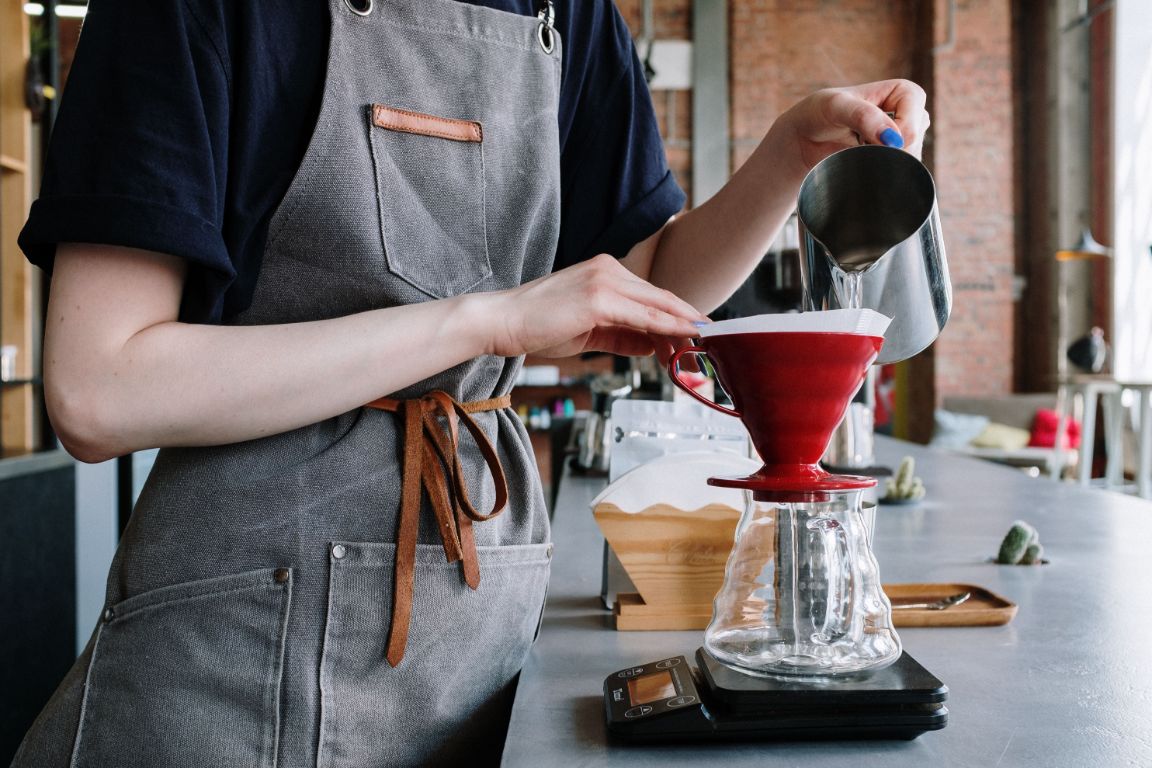
Choose a French press when you want rich, full-bodied coffee, an easy brewing routine, and the ability to make several cups without standing over the brewer.
Choose pour over when you prefer a cleaner cup, want more control over extraction, and do not mind paying attention to the pour for a few minutes.
Neither method is automatically better. French press is generally easier and more forgiving. Pour over gives you more control, but the result depends more heavily on your grind, pouring technique, dripper, filter, and kettle.
French press vs pour over at a glance
| Feature | French press | Pour over |
|---|---|---|
| Brewing method | Full immersion | Water flows through a coffee bed |
| Typical cup | Rich, heavy and textured | Clean, clear and defined |
| Grind size | Coarse | Medium to medium-fine |
| Filter | Metal mesh | Usually paper |
| Sediment | Some is normal | Usually very little |
| Hands-on time | Low after pouring | Requires attention during brewing |
| Typical brew time | About 4 minutes | Usually around 2:30–4:00 |
| Serving size | Easy to make several cups | Depends on the dripper |
| Equipment | Press, kettle and timer | Dripper, filters, kettle, scale and timer |
| Cleanup | Loose wet grounds | Lift out the filter and rinse |
| Learning curve | Lower | Moderate |
| Best for | Easy batches and heavier coffee | Precision and flavor clarity |
The methods extract coffee differently
A French press and a pour-over brewer may use similar coffee-to-water ratios, but the water interacts with the grounds in different ways.
French press uses immersion
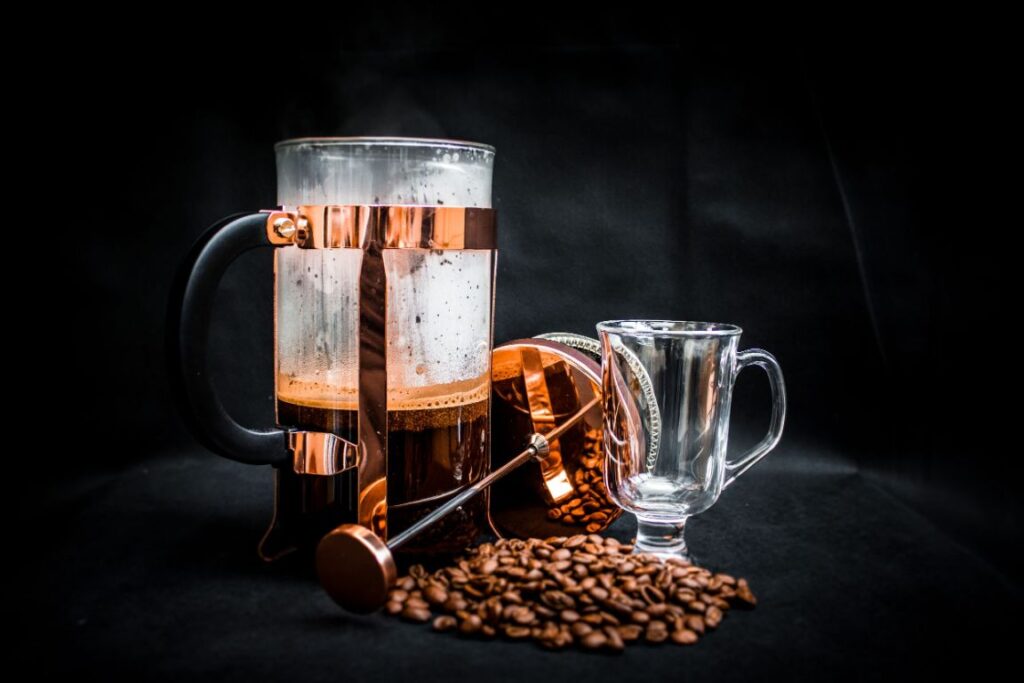
In a French press, all the ground coffee sits in all the brewing water for most of the process.
You add the water, let the coffee steep, then lower a metal mesh filter to separate the grounds from the drink.
Bodum’s standard instructions call for coarsely ground coffee, a four-minute steep, and a slow press. Stumptown also uses a four-minute method and describes French press as a reliable way to make several cups of heavy-bodied coffee.
Because all the coffee remains immersed, you do not need to control a continuous stream of water. Once the grounds are saturated, most of the brewing happens without your involvement.
Pour over uses flowing water
With pour over, hot water moves through a bed of coffee and drains through a filter into a mug or carafe.
You influence the result through:
- grind size
- pouring speed
- water distribution
- the number of pours
- bloom time
- total brew time
- filter and dripper design
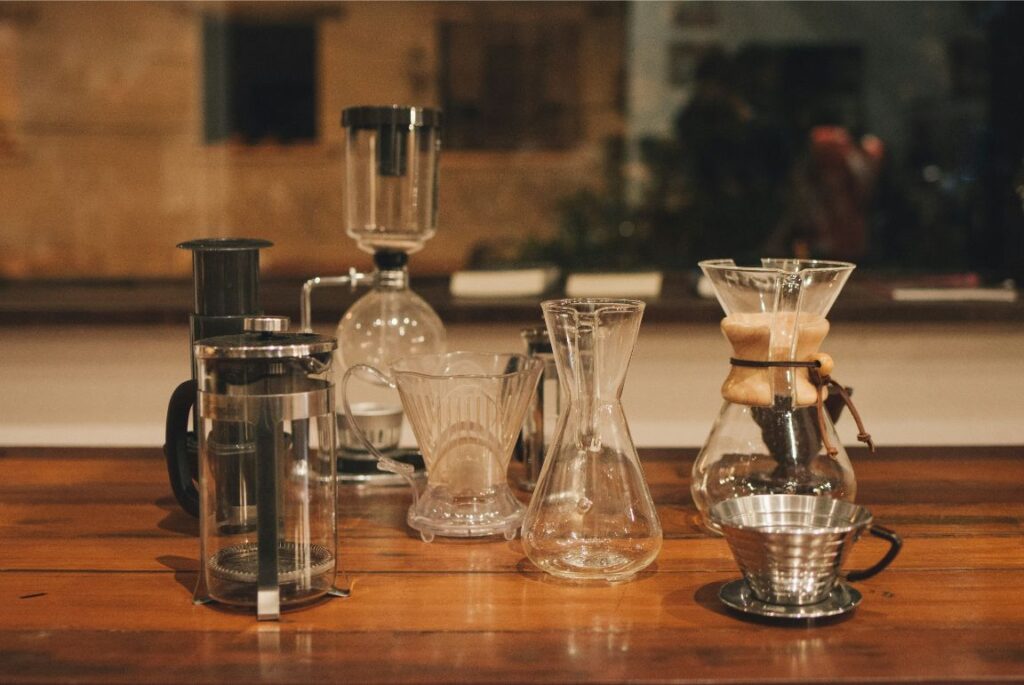
A Hario V60, Chemex, and flat-bottom dripper are all pour-over brewers, but they do not behave identically. Hario’s V60 has relatively unrestricted flow and responds strongly to pouring technique, while Chemex recommends a medium-coarse grind and uses its own bonded paper filters.
For this comparison, the baseline pour-over recipe uses a common single-cup conical dripper with a paper filter.
Which coffee tastes better?
That depends on what you enjoy in a cup.
French press taste
French press coffee is normally associated with:
- more body
- a heavier mouthfeel
- more visible coffee oils
- some fine sediment
- a rounder, less filtered texture
The metal mesh holds back the larger grounds but does not filter the coffee as completely as paper.
This often suits people who enjoy rich, deep cups and do not mind a small amount of sediment near the bottom. Bodum and established roasters commonly describe French press coffee as full-bodied or heavy-bodied.
French press is not limited to dark-roasted coffee. Light, medium, and dark roasts can all work. However, the heavier texture can make subtle flavors feel less separated than they might through a paper filter.
Pour-over taste
Paper-filtered pour over usually produces a cleaner drink with less grit and clearer separation between flavors.
This can make it easier to notice:
- fruit-like acidity
- floral aromas
- sweetness
- differences between origins
- changes caused by grind and pouring
Stumptown describes Chemex coffee as clean and delicate because of its thicker filter, while its V60 guidance emphasizes a bright, crisp cup and greater control through pouring technique.
Pour over is not automatically lighter or weaker. You can brew a strong pour over by using a tighter ratio or finer grind. The defining difference is usually clarity rather than strength.
Pour over is a category, not one brewer
This is one of the most important details to understand before choosing.
Cone-shaped drippers
Examples include the Hario V60.
They tend to let the user control flow through grind size and pouring technique. The V60’s large opening and spiral structure allow fast or slow flow depending on how you pour.
They are flexible, but mistakes in pouring or grind can become noticeable.
Flat-bottom drippers
Examples include the Kalita Wave.
A flat coffee bed can encourage more even extraction and may be easier for a beginner to repeat. Stumptown describes the Wave’s flat-bottom design as supporting even extraction and provides a roughly three-minute brewing method.
Chemex
Chemex combines a dripper and carafe.
Its bonded paper filters are thicker than many standard pour-over filters, and Chemex recommends a medium-coarse grind. It can also brew larger batches than many single-cup drippers.
So the question is not only French press versus pour over. It is also which kind of pour-over brewer fits your routine.
Fair starting recipes
Both recipes use approximately 60 grams of coffee per liter of water, equivalent to a ratio near 1:16.7. The Specialty Coffee Association identifies 60 g/L as a commonly used starting ratio for drip and immersion brewing.
These are starting points, not universal rules.
French press recipe box
| Setting | Starting point |
|---|---|
| Coffee | 30 grams |
| Water | 500 grams |
| Ratio | About 1:16.7 |
| Grind | Coarse, similar to coarse breadcrumbs |
| Temperature | About 200°F / 93°C |
| Steep time | 4 minutes |
| Press | Slow and steady |
| Total time | About 5–6 minutes including setup |
| Expected result | Two moderate cups with rich body and some sediment |
French press steps
- Preheat the press with hot water, then discard it.
- Add 30 grams of coarse coffee.
- Pour in 500 grams of hot water, wetting all the grounds.
- Stir gently if dry pockets remain.
- Place the lid on without pressing.
- At four minutes, lower the plunger slowly.
- Pour the coffee immediately.
Bodum specifies a coarse grind and four-minute brew, while Stumptown recommends transferring coffee that is not served immediately so that it does not continue sitting with the grounds.
Pour-over recipe box
| Setting | Starting point |
|---|---|
| Coffee | 15 grams |
| Water | 250 grams |
| Ratio | About 1:16.7 |
| Grind | Medium-fine |
| Temperature | About 200°F / 93°C |
| Bloom | 45 grams for 30–40 seconds |
| Main pour | Add water gradually to 250 grams |
| Total brew time | About 2:30–3:30 |
| Expected result | One clean, balanced cup with clear flavor separation |
Pour-over steps
- Place the paper filter in the dripper.
- Rinse the filter with hot water and discard the rinse water.
- Add 15 grams of medium-fine coffee.
- Start the timer and pour 45 grams of water over all the grounds.
- Wait 30–40 seconds.
- Continue pouring slowly in controlled circles.
- Reach 250 grams of total water.
- Let the water drain completely.
- Remove the dripper and gently swirl the coffee before drinking.
Counter Culture’s V60 method uses a medium-fine grind, a bloom equal to roughly twice the coffee dose, and a target drawdown of about 3:30–4:00 for a larger 30-gram recipe. Blue Bottle’s pour-over guidance places total brewing time around 2:30–3:30, depending on coffee and grind.
Our smaller recipe may finish toward the lower end of that range.
Which is easier for beginners?
French press is easier for most beginners.
You need to measure the coffee and water, but the pouring technique is not demanding. Once all the grounds are wet, you mostly wait.
Pour over requires more attention.
You need to control:
- where the water lands
- how quickly you pour
- how high the water level rises
- whether the coffee bed drains evenly
- whether the final brew runs too quickly or slowly
A flat-bottom dripper can reduce some of that difficulty. A V60 generally gives the user more control but can also be less forgiving because its flow is relatively unrestricted.
Choose French press when you want a method that works well without turning brewing into a technique exercise.
Choose pour over when learning and adjusting the process sounds enjoyable.
Which is easier to repeat?
French press is less sensitive to pouring, but it still benefits from consistent measurements.
Once you establish a ratio, you can repeat the same process with:
- the same dose
- the same water amount
- the same grind
- the same four-minute steep
Pour over introduces additional variables. A slightly different pour can change how water moves through the coffee bed.
However, pour over can become very repeatable when you use:
- a digital scale
- a timer
- a consistent pouring pattern
- a gooseneck kettle
- the same filter and dripper
The Hario V60 is designed to let pouring speed affect the body and flow of the drink. That flexibility is useful, but it also means technique becomes part of the recipe.
How to tell whether French press coffee worked
A successful French press brew should:
- smell fresh and developed
- taste full without feeling aggressively bitter
- contain only a modest amount of sediment
- allow the plunger to move with steady resistance
- remain enjoyable as it cools
A small amount of grit is normal. A thick muddy layer usually points to a grind that is too fine or inconsistent.
When French press coffee tastes weak
Try:
- using more coffee
- grinding slightly finer
- extending the steep by 30–60 seconds
- checking that all grounds were saturated
- using fresher beans
Change only one variable at a time.
When it tastes bitter or muddy
Try:
- grinding coarser
- reducing the steep time
- using slightly cooler water
- pressing more slowly
- pouring the coffee out immediately
- cleaning the mesh filter thoroughly
A plunger that is unusually difficult to lower is often a sign that the grind contains too many fine particles.
How to tell whether pour-over coffee worked
A successful pour-over brew should:
- drain at a steady pace
- have no large dry areas during brewing
- produce a relatively level coffee bed
- taste clear rather than watery
- show sweetness without harsh dryness
- finish within a reasonable range for the chosen recipe
Do not judge the brew only by whether the coffee bed looks perfect. Taste is more important than appearance.
When pour over drains too quickly
The coffee may taste thin, sour or underdeveloped.
Try:
- grinding slightly finer
- pouring more slowly
- using an additional pour
- checking whether water is bypassing the coffee bed
- using a little more coffee
Chemex identifies an overly coarse grind as a common reason for water passing through too quickly.
When it drains too slowly
The coffee may taste heavy, bitter or dry.
Try:
- grinding coarser
- reducing agitation
- pouring more gently
- checking whether the filter is blocking the dripper’s air channel
- using fewer small pours
Chemex notes that an overly fine grind can clog the filter and cause slow drainage.
When one side drains faster
Your pour may be favoring one part of the coffee bed.
Pour more evenly and avoid directing every pour against the filter wall. A gooseneck kettle makes controlled pouring easier, especially with a V60-style dripper.
Does pour over require more equipment?
Usually, yes.
Basic French press setup
You need:
- French press
- kettle
- coffee
- grinder or suitable pre-ground coffee
- timer
- scale or measuring spoon
Basic pour-over setup
You need:
- dripper
- compatible paper filters
- mug or carafe
- kettle
- coffee
- grinder
- timer
- scale
A normal kettle can work, but a gooseneck kettle gives you better control over flow and placement. Experienced brewing guides commonly recommend one for precision-focused brewers such as the V60.
French press is therefore simpler when you want to buy fewer pieces.
Pour over becomes more appealing when you enjoy using a scale and adjusting small details.
Which one makes more coffee?
Both can make one or several cups, but capacity depends on the model.
French presses are commonly available in sizes ranging from small single-serving models to large family-sized carafes.
Pour-over capacity varies by brewer:
- Small V60 drippers suit one cup.
- Larger V60 sizes can serve several cups.
- A Kalita Wave is commonly used for one or two servings.
- Chemex models can brew larger batches.
Hario lists its V60 size 02 sets for approximately one to four cups, while Chemex allows users to adjust the coffee and water amount up to the brewer’s stated capacity.
French press is easier when you regularly make a large batch because you pour all the water at once.
Large pour-over batches require maintaining an even pour over a wider and deeper bed of coffee.
Which is faster?
The listed brew times are quite close.
French press typically steeps for four minutes. Pour over often drains in roughly three minutes, though this depends on the brewer, dose and grind.
The real difference is how those minutes feel.
French press
You spend a short time pouring, then wait.
During the steep, you can:
- prepare breakfast
- clean the grinder
- get a mug ready
- do something else nearby
Pour over
You remain involved for most of the brew.
The process may include:
- blooming
- several timed pours
- watching the water level
- adjusting the flow
Pour over may finish slightly sooner, but French press often requires less active attention.
Which is easier to clean?
Pour over usually has the simpler grounds disposal.
After brewing:
- Lift out the paper filter.
- Dispose of or compost the filter and grounds.
- Rinse the dripper.
French press leaves loose, wet grounds at the bottom of the carafe.
You need to:
- Scoop or strain out the grounds.
- Avoid washing a large amount into the sink.
- Rinse the carafe.
- Clean the plunger and mesh.
- Occasionally disassemble the filter.
Bodum recommends washing its French press components in warm, soapy water, with dishwasher suitability depending on the specific model.
Pour over creates paper waste unless you use a reusable filter. French press does not require disposable filters.
So the better cleanup depends on which inconvenience bothers you more:
- paper filters and replacement supplies
- loose wet grounds and mesh cleaning
Which is better for light and dark roasts?
Both can brew any roast level.
Light roasts
Pour over can make it easier to notice bright, floral or fruit-like characteristics because the paper filter creates a cleaner cup.
Light roasts may require:
- hotter water
- a slightly finer grind
- more careful pouring
- a longer total contact time
Dark roasts
French press can suit deeper, heavier flavor profiles because the metal filter preserves more body.
Dark roasts may benefit from:
- slightly cooler water
- a coarser grind
- a shorter steep
- a gentler ratio
These are starting adjustments, not fixed rules. Roast is only one variable. Origin, processing, freshness and personal taste also affect the result.
Which is better with milk?
Neither brewer produces espresso-strength coffee by default.
French press generally makes a heavier cup, so it can handle a splash of milk without losing as much body.
Pour-over coffee is often chosen for clarity, and adding a large amount of milk can hide the qualities the brewing method highlights.
For milk drinkers:
- Choose French press for a rich mug with some milk.
- Choose pour over when you mainly drink coffee black or add only a small amount.
- Choose a moka pot or espresso machine when you want a concentrated base for latte-style drinks.
See our Moka Pot vs French Press comparison for the concentrated-coffee alternative.
Which works better for travel?
A lightweight plastic or metal pour-over dripper can be very easy to pack.
You only need:
- dripper
- paper filters
- coffee
- mug
- access to hot water
French presses are bulkier because they include a carafe and plunger. Glass models can also be fragile.
However, travel presses and stainless-steel presses are available and can combine the brewer and drinking cup.
Choose pour over for the lightest packing setup. Choose French press when you want to brew and drink from one insulated container and do not mind handling wet grounds afterward.
Common mistakes when choosing
Assuming pour over always tastes better
Pour over gives you more control, but that control does not guarantee a better cup.
A poorly poured brew can be uneven. A simple French press recipe may be more consistent for someone who does not want to practice technique.
Assuming French press is always bitter
French press should not automatically taste bitter.
Bitterness may result from:
- coffee that is ground too fine
- an excessive steep time
- very dark coffee
- overly hot water
- leaving the finished drink on the grounds
Buying pour-over equipment without considering filters
Each dripper may require a specific filter size and shape.
Check whether replacement filters are easy to buy where you live.
Using the same grind for both methods
French press normally needs a much coarser grind than a V60-style pour over.
See our Coffee Grind Size Chart for a practical starting reference.
Leaving French press coffee in the brewer
Pressing does not completely remove the liquid from the coffee grounds.
Pour the finished coffee into mugs or a separate carafe when it will not be served immediately.
Treating every pour-over brewer as identical
A Chemex, V60 and flat-bottom dripper may require different grinds, pouring patterns and brew times.
Follow a recipe written for your specific brewer.
Choose French press when…
French press is the better fit when:
- you like rich, heavy coffee
- you do not mind some sediment
- you regularly brew several cups
- you want a low-attention method
- you prefer not to buy paper filters
- you want a straightforward beginner routine
- you enjoy adding a little milk
- you do not want to learn precise pouring
- you already have a normal kettle
Choose pour over when…
Pour over is the better fit when:
- you prefer clean, clear coffee
- you drink coffee mostly black
- you enjoy lighter or more distinctive coffees
- you like controlling brewing variables
- you normally make one cup
- you want fast grounds disposal
- you do not mind buying filters
- you are comfortable using a scale and timer
- you enjoy an active coffee-making routine
Is it useful to own both?
Yes, because they serve different moods and situations.
A practical setup might use:
- Pour over: one carefully brewed cup on quiet mornings
- French press: larger batches, guests or busy breakfasts
Owning both is unnecessary when you strongly prefer one coffee texture.
Someone who dislikes sediment may rarely use the French press. Someone who finds timed pouring tedious may stop using the pour-over dripper after the novelty fades.
Start with the method that matches an ordinary weekday, not only the method that looks appealing in coffee videos.
Frequently asked questions
Is French press coffee stronger than pour over?
It often feels heavier because more oils and fine particles remain in the cup. Actual strength depends primarily on the coffee-to-water ratio and extraction.
Which method has more caffeine?
Neither automatically has more. Caffeine depends on the coffee dose, beans, extraction and serving size.
Which is better for beginners?
French press is generally easier because the brew does not depend on controlled pouring. A flat-bottom pour-over dripper can also be beginner-friendly.
Does pour over taste less bitter?
It can taste cleaner, but it is not automatically less bitter. Grind that is too fine, slow drainage or excessive agitation can still create harsh flavors.
Can I use pre-ground coffee?
Yes, but the grind should match the method. French press needs coarse coffee, while most pour-over brewers use medium or medium-fine coffee.
Do I need a gooseneck kettle for pour over?
No, but it helps control pouring speed and direction. It is especially useful with fast-flowing cone drippers such as the V60.
Can I make several cups with pour over?
Yes, provided the dripper and carafe are large enough. A French press is often easier for large batches because all the water is added at once.
Which is easier to clean?
Pour over usually wins because the filter and grounds can be removed together. French press does not require paper filters but leaves loose grounds in the carafe.
The takeaway
Choose French press for rich body, larger batches and a relaxed four-minute routine.
Choose pour over for cleaner flavor, direct control and easier grounds disposal.
The real trade-off is simplicity versus precision. French press removes most of the pouring technique. Pour over rewards attention but asks you to participate throughout the brew.
The better choice is the one you will enjoy making on a normal morning.