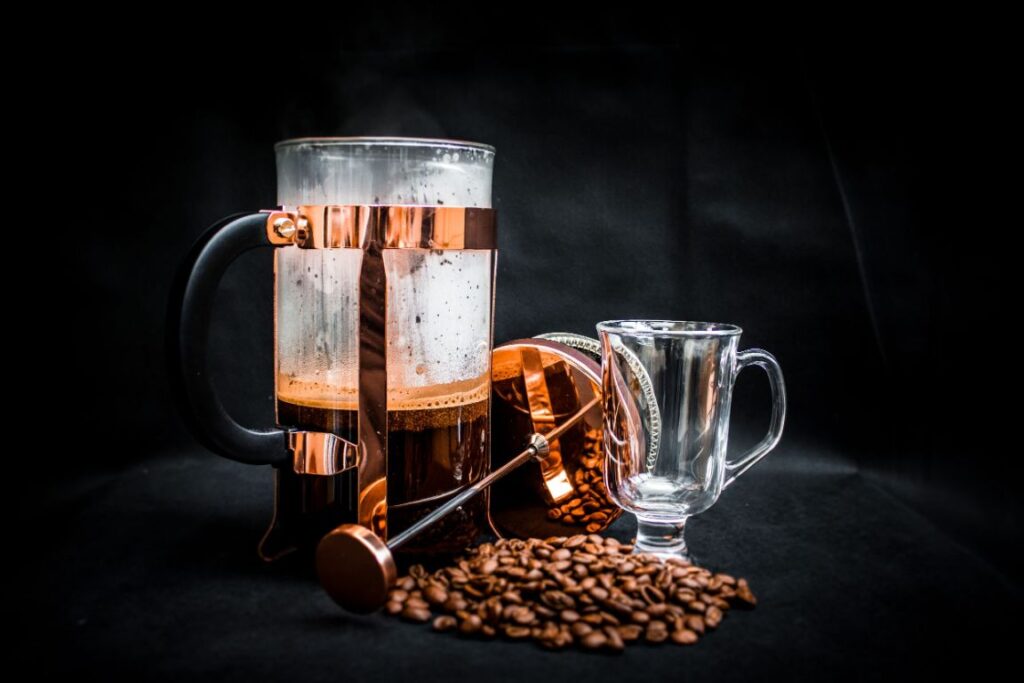
Choose a French press when you want rich, full-bodied coffee and do not mind measuring, steeping, pressing, and dealing with loose grounds afterward.
Choose a drip coffee maker when convenience matters more: you want to load the machine, press a button, and make several cups with little attention.
The biggest difference is not simply manual versus automatic. French press keeps the coffee immersed in water and uses a metal mesh filter, while drip machines move hot water through a filtered coffee bed. That changes the texture, flavor clarity, daily effort, and cleanup.
A note about “drip coffee”
In this comparison, drip coffee means coffee made with an automatic electric drip machine.
Manual pour-over brewers also use gravity and filtration, but they require active pouring and offer a different level of control. We compare those separately in French Press vs Pour Over.
French press vs drip coffee at a glance
| Feature | French press | Automatic drip coffee |
|---|---|---|
| Brewing method | Full immersion | Water flows through a coffee bed |
| Typical flavor | Rich, round and heavy | Clean, smooth and balanced |
| Grind size | Coarse | Medium to medium-coarse |
| Filter | Metal mesh | Usually paper; reusable filters available |
| Sediment | Some is normal | Very little with paper filters |
| Daily effort | Measure, pour, wait and press | Add water and coffee, then start |
| Attention required | Low during steeping | Very low once started |
| Batch size | Depends on press capacity | Often designed for several cups |
| Programmable brewing | No | Available on many machines |
| Cleanup | Loose wet grounds and mesh | Filter disposal plus basket and carafe |
| Long-term maintenance | Mostly manual washing | Cleaning plus periodic descaling |
| Best for | Body, simplicity and manual control | Busy mornings and household batches |
How the brewing methods differ
Both methods can use similar coffee-to-water ratios, but the coffee and water interact differently.
French press uses full immersion
With French press, the ground coffee sits directly in the full amount of brewing water.
After several minutes, you lower a plunger fitted with a metal mesh screen. The screen pushes most of the grounds downward, but it does not remove the brewed coffee from contact with them completely.
Bodum’s standard method calls for coarse coffee, a four-minute steep, and slow plunging.
The process gives you control over:
- coffee dose
- water amount
- grind size
- water temperature
- steep time
- when the coffee is poured
Once the water is added, however, you can mostly leave the press alone until the timer finishes.
Drip machines automate water delivery
An automatic drip machine heats water and distributes it over coffee held in a brew basket.
The water moves through the grounds and filter before collecting in a carafe or mug. Once the machine is started, it handles most of the brewing process.
The machine’s design influences:
- water temperature
- water distribution
- contact time
- flow rate
- how evenly the grounds become saturated
This is why two drip machines can produce noticeably different results even when you use the same coffee and ratio.
The Specialty Coffee Association’s certified-home-brewer program uses third-party testing to evaluate machines for brewing quality, consistency, and performance. Certification does not mean every owner will prefer the coffee, but it can help identify machines designed around established brewing requirements.
How the coffee tastes
French press produces more body
French press coffee normally feels fuller and heavier because the metal filter allows more oils and fine particles into the cup.
You may notice:
- a rounder mouthfeel
- more texture
- visible oils on the surface
- a small amount of sediment
- less separation between delicate flavors
- a lingering finish
This style often suits people who enjoy chocolate, nut, caramel, spice, or deeper roasted flavors.
That does not mean French press only works with dark coffee. Lighter roasts can also be brewed successfully, though their delicate characteristics may feel less distinct than they would through paper filtration.
Paper-filtered drip coffee tastes cleaner
Most automatic drip machines use paper filters.
Paper catches more oils and fine particles, usually producing:
- less sediment
- a cleaner finish
- clearer flavor separation
- a lighter perceived body
- a more familiar everyday coffee texture
A reusable metal filter changes that result. It allows more oils and fines through, bringing drip coffee somewhat closer to French press in body, although the brewing mechanism remains different.
Moccamaster recommends white paper filters for its brewers and a medium-coarse grind resembling sea salt or coarse sand.
Which method makes better coffee?
Neither wins automatically.
A carefully measured French press can outperform a poorly designed drip machine. A well-built drip brewer can be more consistent than a French press prepared differently every morning.
French press quality depends heavily on the person making it:
- Did you measure the coffee?
- Was the grind coarse and reasonably even?
- Was all the coffee saturated?
- Did you steep for a consistent time?
- Did you pour the finished coffee promptly?
Drip quality depends partly on the machine:
- Does it heat the water effectively?
- Does the showerhead distribute water evenly?
- Does it handle the selected batch size well?
- Is the machine clean and free from mineral buildup?
- Is the brew basket the correct size for the dose?
Our editorial view is simple: French press gives you more direct control, while a good drip machine gives you easier repeatability.
Practical starting recipes
These recipes use the same starting ratio so you can compare the methods fairly.
A common brewing baseline is 60 grams of coffee per liter of water, equivalent to approximately 1:16.7.
Your preferred strength, coffee, and brewer may require adjustment.
French press recipe box
| Setting | Starting point |
|---|---|
| Coffee | 30 grams |
| Water | 500 grams |
| Ratio | About 1:16.7 |
| Grind | Coarse |
| Temperature | About 200°F / 93°C |
| Steep time | 4 minutes |
| Press | Slow and steady |
| Total routine | About 5–6 minutes |
| Expected result | Two moderate cups with rich body and light sediment |
French press steps
- Warm the press with hot water, then empty it.
- Add 30 grams of coarsely ground coffee.
- Pour in 500 grams of hot water.
- Make sure all the grounds become wet.
- Stir gently only when dry pockets remain.
- Place the lid on without pressing.
- Wait four minutes.
- Lower the plunger slowly.
- Pour all the coffee you plan to drink immediately.
Do not leave the remaining drink sitting in the press for a long period. The liquid remains close to the grounds even after plunging, which can make the final serving taste heavier or harsher.
Automatic drip recipe box
| Setting | Starting point |
|---|---|
| Coffee | 30 grams |
| Water | 500 grams |
| Ratio | About 1:16.7 |
| Grind | Medium to medium-coarse |
| Filter | Paper filter suitable for the basket |
| Temperature | Controlled by the machine |
| Brew time | Use the machine’s normal cycle |
| Expected result | A clean, balanced batch with little sediment |
Automatic drip steps
- Confirm that the carafe and brew basket are clean.
- Add fresh water to the reservoir.
- Insert the correct paper filter.
- Rinse the filter when your machine and basket make this practical.
- Add 30 grams of medium or medium-coarse coffee.
- Gently level the coffee bed without pressing it down.
- Position the carafe correctly.
- Select the appropriate batch setting.
- Start the machine.
- Gently swirl the finished carafe before serving.
Moccamaster recommends 55 grams of coffee per liter, which works out to approximately 28 grams for 500 milliliters. It also notes a tolerance of several grams in its dose chart.
That is close to the 30-gram baseline above. Follow your own machine’s instructions when they provide a specific ratio or minimum batch size.
Which is easier on a busy morning?
Drip coffee wins for convenience.
With a programmable machine, you may be able to:
- fill the reservoir the night before
- load the filter and coffee
- set an automatic start time
- wake up to a finished batch
- keep several servings in a carafe
Even without programming, the active work is brief. Once the cycle begins, you can prepare breakfast or leave the kitchen.
French press requires you to:
- Heat water separately.
- Measure the coffee.
- Pour the water.
- Start a timer.
- Return after four minutes.
- Press.
- Pour.
- Handle the wet grounds.
None of these steps is difficult, but forgetting the timer or leaving the coffee in the press can change the result.
Choose drip when coffee needs to fit around your morning.
Choose French press when making coffee is part of the morning.
Which is better for making several cups?
Automatic drip machines are generally more convenient for larger batches.
Many home machines are designed around multi-cup carafes, though their definition of a “cup” may be smaller than your usual mug. Check the stated ounce or liter capacity instead of relying only on labels such as eight-cup or ten-cup.
French presses are also available in large sizes, but they become less convenient as the batch grows.
A large press means:
- more loose grounds to remove
- more glass or metal to lift
- greater heat loss in some glass models
- a larger plunger to clean
- more risk of overbrewing if the entire batch is not served
For one or two people, either method works.
For a household where several people want coffee at roughly the same time, drip is usually easier.
Which is better for one person?
French press can work well for one person when you buy the correct size.
A small press lets you brew one full mug without operating a large appliance. It also takes little counter space and can be stored easily.
Drip machines vary.
Some full-size machines do not perform as well with very small batches, while others include a dedicated half-pot or single-serving setting. The SCA’s current certified-equipment list includes both multi-cup brewers and machines with podless single-serve functions.
Before buying a drip machine for one person, check:
- minimum recommended batch
- single-cup support
- physical footprint
- filter size
- whether the machine includes a suitable small-batch mode
French press is simpler when you make one mug and do not need automation.
Drip is better when you value push-button brewing enough to give up more counter space.
Which method is more consistent?
A good drip machine is more repeatable once you establish the dose and grind.
The machine controls the water delivery each time. You still need to use consistent coffee, water, filters, and cleaning, but you do not have to repeat a manual pouring or steeping technique.
French press is also highly repeatable when you measure carefully.
Consistency usually breaks down when someone:
- uses scoops of varying size
- guesses the water amount
- changes steep time
- uses unevenly ground coffee
- pours one batch immediately but leaves another sitting
- changes several variables at once
A scale and timer solve much of this.
Drip is easier to repeat without attention.
French press is easy to repeat when you are willing to measure.
How to tell whether French press coffee worked
A successful French press brew should:
- smell developed rather than flat
- have noticeable body
- taste rich without harsh bitterness
- contain only a modest amount of sediment
- allow the plunger to lower steadily
- remain pleasant as it cools
A little grit is normal.
A thick layer of sludge suggests the grind may be too fine or inconsistent.
When French press coffee tastes weak
Try one adjustment:
- use slightly more coffee
- grind a little finer
- extend the steep by 30 seconds
- make sure every ground becomes wet
- use fresher coffee
When it tastes bitter or muddy
Try:
- grinding coarser
- shortening the steep
- using slightly cooler water
- pressing more gently
- pouring immediately
- cleaning the mesh filter thoroughly
Do not force a plunger that feels unusually difficult. Very fine coffee can clog the mesh and create excessive resistance.
How to tell whether drip coffee worked
A good drip batch should:
- smell fresh when the cycle finishes
- taste balanced rather than watery
- have no strong paper flavor
- contain little sediment when using paper filtration
- finish brewing without overflowing the basket
- show reasonably even saturation across the grounds
The final coffee bed may not look perfectly flat in every machine. Taste matters more than appearance.
When drip coffee tastes weak
Check:
- whether enough coffee was used
- whether the grind is too coarse
- whether the machine is brewing too small a batch
- whether the coffee is stale
- whether water is bypassing parts of the bed
- whether the machine needs cleaning or descaling
When it tastes bitter or dry
Try:
- grinding slightly coarser
- using a little less coffee
- confirming that the filter is not slowing flow excessively
- brewing a larger batch when the machine performs poorly at its minimum setting
- cleaning the basket and showerhead
- descaling according to the manual
When the brew basket overflows
Possible causes include:
- coffee ground too finely
- using too much coffee
- using the wrong filter
- accidentally using two paper filters
- a blocked basket outlet
- the carafe not opening the drip-stop mechanism correctly
OXO’s brewer guidance specifically identifies fine grounds, doubled filters, blocked drainage, and incorrect carafe positioning as possible causes of overflow.
Grind size matters differently
French press generally requires a coarse grind.
The large particles help:
- reduce sediment
- keep the plunger moving
- prevent the cup from becoming overly muddy
- suit the longer immersion time
Automatic drip usually uses a medium or medium-coarse grind.
The exact setting depends on:
- basket shape
- filter type
- batch size
- machine flow rate
- coffee density
- roast level
A flat-bottom basket and cone basket may not need identical settings.
Use brew time and taste together:
- Fast flow and thin coffee: try finer.
- Slow flow and harsh coffee: try coarser.
- Good flow but weak flavor: adjust dose before making a dramatic grind change.
See our Coffee Grind Size Chart for a practical starting reference.
Paper filters versus metal filters
The filter influences more than cleanup.
French press mesh
The built-in mesh:
- requires no disposable paper
- lets more oils into the cup
- allows some fine sediment through
- needs occasional disassembly and cleaning
Drip paper filter
Paper filtration:
- catches more oils and fine particles
- produces a cleaner cup
- makes grounds disposal easier
- creates ongoing filter waste
- requires buying the correct size and shape
Reusable drip filter
A reusable metal filter:
- reduces paper use
- lets more oils and fines through
- produces more body
- requires washing after each use
- can develop stale coffee-oil buildup when not cleaned properly
Someone who likes French press flavor but prefers drip convenience may enjoy a reusable filter.
Someone who dislikes sediment should stay with paper.
Cleaning and long-term maintenance
French press maintenance
Daily cleaning involves:
- Removing the grounds.
- Rinsing the carafe.
- Washing the plunger and mesh.
- Letting the components dry.
The mesh assembly should occasionally be taken apart so trapped oils and particles can be removed.
The main challenge is grounds disposal. Avoid sending a large amount of coffee grounds into the sink.
Drip-machine maintenance
Daily cleaning usually involves:
- disposing of the filter and grounds
- rinsing the brew basket
- cleaning the carafe
- wiping the warming plate when present
Long-term maintenance also includes:
- cleaning removable components
- checking the showerhead or water outlet
- removing coffee-oil buildup
- descaling mineral deposits
- replacing water filters when the machine uses them
Drip machines hide part of the water path inside the appliance, so neglect can be less visible than it is with a French press.
Mineral buildup can slow a machine’s brew cycle and interfere with performance, which is why manufacturer manuals include descaling procedures.
Follow the schedule and cleaning product recommended for your specific model.
Glass carafe or thermal carafe?
This question only affects drip machines, but it can change the daily experience.
Glass carafe with warming plate
Advantages:
- you can see how much coffee remains
- often costs less
- keeps coffee hot while the plate remains on
Limitations:
- requires electricity to maintain heat
- the carafe can break
- coffee may become less pleasant when held hot for a long time
Thermal carafe
Advantages:
- holds heat without a warming plate
- works well when coffee will be consumed gradually
- usually feels more durable than thin glass
Limitations:
- harder to see how much remains
- can be more difficult to clean
- may retain stale smells when the lid is not cleaned thoroughly
French press users face a similar choice between glass and insulated stainless-steel models.
A stainless press holds heat better and resists breakage. A glass press makes it easier to see the brew and is often less expensive.
Which method costs less?
French press usually has the lower initial cost.
A basic setup requires:
- the press
- a kettle
- coffee
- a grinder or appropriate pre-ground coffee
There are no paper filters to keep buying.
Automatic drip machines range from inexpensive basic models to precision brewers with thermal carafes, programmable schedules, bloom cycles, adjustable strength, and single-serving modes.
Drip also adds possible ongoing costs:
- paper filters
- water filters
- descaling products
- replacement carafes
- replacement machine parts
French press is not automatically cheaper when you still need to buy a quality kettle and grinder, but the brewer itself is mechanically simple.
Choose based on the workflow you value, not only the purchase price.
Which works better with milk?
French press coffee may feel richer after adding milk because more oils and fine particles remain in the cup.
It works well with:
- a splash of milk
- cream
- sweetened condensed milk
- a moderate amount of frothed milk
Paper-filtered drip coffee has a cleaner and lighter body, but it can still work well with milk when brewed at an appropriate ratio.
Neither method produces espresso concentration by default. A large latte-style drink can overwhelm both unless you make a stronger batch.
For a more concentrated manual option, see Moka Pot vs French Press.
Common misunderstandings
“French press coffee is always stronger”
French press often feels stronger because it has more body.
Actual brew strength depends on the coffee-to-water ratio and extraction. A drip machine can produce a stronger cup when you use a tighter ratio.
“Drip coffee is always weak”
Low-quality machines, stale coffee, too little coffee, and incorrect grind can produce weak drip coffee.
A suitable machine with a measured recipe can make balanced, flavorful coffee.
“French press always tastes bitter”
Bitterness is not a required feature.
Excessive steeping, coffee ground too finely, very dark beans, stale residue, or leaving the coffee in the press can all contribute.
“Expensive drip machines require no technique”
A better machine can improve control over water and flow, but you still need:
- fresh coffee
- suitable grind
- correct dose
- clean equipment
- appropriate batch size
“Drip coffee and pour over are the same”
They share gravity-based filtration, but automatic drip machines control water delivery for you.
Manual pour over keeps the person involved throughout the brew. Read French Press vs Pour Over for that comparison.
Choose a French press when…
French press fits you better when:
- you enjoy rich, textured coffee
- you do not mind some sediment
- you want a low-cost manual brewer
- you usually make one or two mugs
- you have limited counter space
- you do not need programmed brewing
- you prefer not to buy paper filters
- you enjoy controlling the recipe
- you are willing to handle loose grounds
Choose a drip coffee maker when…
Drip coffee fits you better when:
- convenience is the priority
- several people drink coffee
- you want a full carafe
- you prefer a cleaner paper-filtered cup
- you want to press a button and walk away
- you value programmable brewing
- you dislike French press sediment
- you want more repeatable water delivery
- you are willing to clean and descale an appliance
Is it useful to own both?
Yes, when each brewer has a clear role.
A practical household might use:
- Drip machine: weekday mornings and larger batches
- French press: weekends, small batches, richer coffee, or travel
Owning both is unnecessary when one method already handles every situation.
Someone who wants several clean cups every morning may rarely reach for a press. Someone who makes one mug and dislikes countertop appliances may not benefit from a drip machine.
Buy the second method because it solves a real limitation, not because it is another way to make coffee.
Frequently asked questions
Does French press coffee taste better than drip coffee?
It tastes different rather than universally better. French press is heavier and more textured. Paper-filtered drip is cleaner and clearer.
Which method makes stronger coffee?
Either can make stronger coffee when you use more coffee relative to the water. French press may feel stronger because more oils and fine particles remain in the cup.
Which contains more caffeine?
Neither automatically contains more. Caffeine depends on bean type, coffee dose, extraction, serving size, and how much you drink.
Which is easier for beginners?
Drip is easier when the machine works well because it automates water heating and delivery. French press is easy to understand but requires measuring and timing.
Which is faster?
The active work is lower with drip because you can leave the machine after starting it. French press takes about four minutes of steeping plus water heating and cleanup.
Can I use the same grind for both?
Not ideally. French press normally needs a coarse grind, while automatic drip commonly uses medium to medium-coarse coffee.
Which is easier to clean?
Drip makes daily grounds disposal easier when using paper filters. French press has no internal water system to descale but leaves loose grounds in the carafe.
Is drip coffee healthier than French press?
This article does not make individualized health recommendations. Anyone choosing a brewing method for a medical or dietary reason should consult an appropriate healthcare professional and evidence-based guidance.
Can French press replace a drip machine?
Yes, when you do not need programmable brewing or a large hands-off batch. It requires more manual work but can cover normal brewed-coffee needs.
The takeaway
Choose French press for rich body, direct control, mechanical simplicity, and small manual batches.
Choose drip coffee for convenience, repeatability, cleaner filtration, and larger household servings.
The real decision is not which method coffee enthusiasts consider more impressive. It is whether you prefer to participate in the brew or let a machine handle most of it.