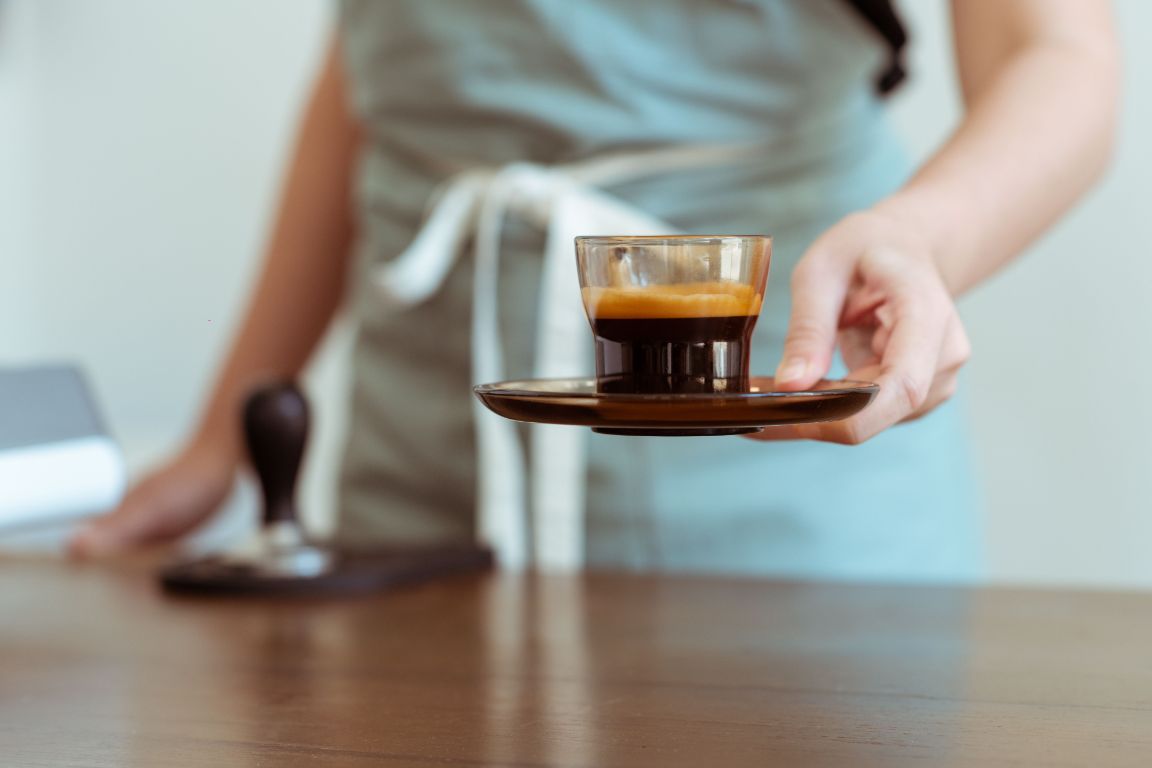
An espresso is a short, concentrated extraction. A lungo uses the same basic espresso method but allows more water to pass through the coffee, producing a larger and less concentrated drink.
A lungo is not simply an espresso topped up with hot water. That would be closer to an Americano.
The extra water changes more than the serving size. It affects the drink’s concentration, body, bitterness, clarity, and the way the grinder should be adjusted.
For most home espresso setups:
- Choose espresso when you want a compact, concentrated shot or a strong base for milk.
- Choose lungo when you want a longer black coffee without adding water afterward.
- Choose an Americano when you like espresso flavor but want a larger, gentler drink without extending the extraction through the coffee puck.
Espresso vs lungo at a glance
| Feature | Espresso | Lungo |
|---|---|---|
| Meaning | A standard concentrated espresso extraction | “Long” espresso extraction |
| Typical brew ratio | Around 1:2 | Often around 1:3 or longer |
| Example with 18 g dose | About 36 g in the cup | About 54–72 g in the cup |
| Grind | Fine | Usually slightly coarser |
| Shot time | Commonly around 25–30 seconds | Can remain near a normal espresso time when properly dialed in |
| Concentration | Higher | Lower |
| Body | Denser and more syrupy | Lighter and thinner |
| Flavor tendency | Concentrated and balanced when dialed in | More open, but may become bitter or dry |
| Best for milk drinks | Usually better | Can become lost in a large amount of milk |
| Same as an Americano? | No | No |
| Coffee dose | Usually unchanged | Usually unchanged |
These ratios are practical starting points rather than universal definitions. Espresso recipes vary across cafés, beans, baskets, and machines.
What is espresso?
Espresso is coffee brewed by forcing hot water through a compact bed of finely ground coffee under pressure.
A Specialty Coffee Association survey of working baristas found a common modern starting point of:
- 18–20 grams of ground coffee
- approximately 36.5 grams of espresso
- a brew ratio close to 1:2
- roughly 25–30 seconds
- around 9 bars of pressure
- water near 200°F or 93°C
Those figures describe a widely used reference, not a rule every shot must obey.
A practical home recipe might therefore use:
18 grams of coffee → 36 grams of espressoThat is a 1:2 ratio because the finished drink weighs twice as much as the dry coffee dose.
When properly dialed in, espresso should feel concentrated and have enough intensity to drink alone or remain noticeable in a cappuccino, flat white, or latte.
What is a lungo?
“Lungo” means “long” in Italian.
A lungo starts like an espresso but continues until more liquid reaches the cup. The dose may remain the same, while the beverage yield increases.
A practical lungo might use:
18 grams of coffee → 54 grams of coffeeThat is a 1:3 ratio.
A longer version might reach:
18 grams of coffee → 72 grams of coffeeThat is a 1:4 ratio.
There is no single globally fixed lungo ratio. Cafés, machines, and capsule systems define the drink differently.
Nespresso’s Original system, for example, programs its espresso at 40 milliliters and its lungo at 110 milliliters. Those are capsule-system serving sizes and should not be treated as a recipe for every portafilter machine.
The most useful definition is:
A lungo is a longer espresso extraction made by passing more brewing water through the coffee.
Espresso and lungo recipe boxes
Standard espresso starting point
| Setting | Starting point |
|---|---|
| Coffee dose | 18 grams |
| Beverage yield | 36 grams |
| Ratio | 1:2 |
| Grind | Fine |
| Water temperature | Around 200°F / 93°C |
| Shot time | Approximately 25–30 seconds |
| Expected result | Concentrated shot with substantial body and balanced flavor |
Lungo starting point
| Setting | Starting point |
|---|---|
| Coffee dose | 18 grams |
| Beverage yield | 54 grams |
| Ratio | 1:3 |
| Grind | Slightly coarser than the espresso setting |
| Water temperature | Start with the same machine setting used for espresso |
| Shot time | Aim for a controlled flow rather than an extremely long extraction |
| Expected result | Larger, lighter shot with less concentration and a more open finish |
These measurements are CoffeeInTown starting recipes. Taste should determine the final setting.
The biggest difference is the brew ratio
The brew ratio compares the weight of dry coffee with the weight of the finished drink.
For example:
| Drink | Dose | Yield | Ratio |
|---|---|---|---|
| Espresso | 18 g | 36 g | 1:2 |
| Short lungo | 18 g | 54 g | 1:3 |
| Long lungo | 18 g | 72 g | 1:4 |
Using weight is more reliable than measuring the drink by volume because crema can make two shots look like different sizes even when their liquid weights are similar.
The longer ratio gives a lungo more liquid, but it also lowers the drink’s concentration. That is why a lungo can be larger yet feel lighter than espresso.
Should a lungo take longer to brew?
Not necessarily by much.
A common beginner mistake is to use the normal espresso grind and simply let the machine continue running until the cup is much fuller.
That can produce a slow, harsh extraction.
A better approach is to grind slightly coarser so more water can flow through without extending the shot excessively. Illy describes its lungo coffee as being ground more coarsely so a greater volume can reach the cup within a similar brewing period.
This does not mean every lungo must finish at exactly 30 seconds. Machines, beans, baskets, and ratios vary.
The practical goal is to avoid turning the lungo into a very long, restricted shot that tastes dry and unpleasant.
How does the taste change?
Espresso taste
Espresso is more concentrated, so its flavors arrive with greater intensity.
A balanced shot may have:
- dense sweetness
- noticeable acidity
- rich body
- a lingering finish
- enough concentration to carry milk
- a prominent crema layer
Because the serving is small, defects can also feel intense. A sour or bitter espresso has nowhere to hide.
Lungo taste
A lungo has more water in the cup and a lower concentration.
It may taste:
- lighter in body
- less syrupy
- less intense per sip
- more open or tea-like
- more bitter or dry when overextended
- easier to sip as a longer black drink
More water passes through the puck, so the final portion of the extraction can contribute flavors that are less pleasant with certain beans.
That does not mean lungos are automatically bitter. A well-adjusted grind and suitable coffee can make a balanced drink.
Is a lungo weaker than espresso?
It depends on what you mean by “weaker.”
A lungo is usually less concentrated. Each sip contains more water relative to the extracted coffee.
However, the entire cup may contain a similar total amount of dissolved coffee material—or sometimes more—because the extraction continues longer.
So both of these statements can be true:
- Espresso tastes more intense.
- Lungo gives you a larger drink.
A lungo is not merely weak espresso. It is a different balance of concentration, extraction, and volume.
Does a lungo contain more caffeine?
A lungo may extract somewhat more caffeine when more water passes through the same dose, but it does not automatically contain twice as much caffeine simply because the cup is twice as large.
Research on time-resolved espresso extraction found that a large portion of caffeine and dissolved solids enters the cup during the early part of the shot. Additional water can continue extracting caffeine, but the increase is not proportional to the increase in beverage volume.
Capsule systems complicate the comparison further because lungo capsules may contain a different amount or blend of coffee.
Nespresso states that some of its lungo blends contain about 20% more ground coffee than its espresso capsules, resulting in approximately 77–89 milligrams of caffeine compared with about 55–65 milligrams for the espresso capsules described in that market.
The practical takeaway:
- The lungo may contain somewhat more caffeine.
- Bean type and coffee dose often matter more than cup volume.
- A larger cup does not automatically mean proportionally more caffeine.
- Capsule-machine figures should not be applied directly to a portafilter recipe.
Is lungo more bitter than espresso?
It can be.
As extraction continues, the balance of compounds entering the cup changes. A lungo made by running a standard espresso grind for too long may become:
- bitter
- drying
- hollow
- woody
- thin despite its bitterness
But bitterness is not guaranteed.
A lungo can taste balanced when you:
- grind slightly coarser
- use a suitable coffee
- stop at a sensible ratio
- maintain an even puck
- avoid excessive shot time
- judge the drink by taste rather than a preset button alone
Darker roasts may become bitter more quickly when extended. Medium or lighter roasts sometimes tolerate longer ratios better, though the result depends on the individual coffee.
How to make a lungo with a semi-automatic espresso machine
This method assumes you have an espresso-capable grinder, a scale, and a non-pressurized basket.
Step 1: Begin with your normal espresso dose
Use the basket dose that already works with your machine.
For example:
18 grams of coffeeKeeping the dose unchanged makes it easier to understand what the longer ratio is doing.
Step 2: Grind slightly coarser
Move the grinder only a small amount coarser than your normal espresso setting.
Do not make a large adjustment immediately. The goal is still espresso-style resistance, not fast-flowing filter coffee.
Step 3: Prepare the puck normally
Distribute the coffee evenly, tamp level, and clear loose grounds from the basket rim.
The preparation should be just as careful as it is for a standard espresso.
Step 4: Place a scale beneath the cup
Measure the beverage by weight rather than relying on the cup markings or crema height.
For an 18-gram dose, begin with a 54-gram target.
Step 5: Start the extraction
Watch the flow.
It should begin slowly and develop into a steady stream. If it runs through almost immediately, the grind is too coarse or the puck preparation is uneven.
Step 6: Stop at a 1:3 ratio
For the first attempt:
18 grams in → 54 grams outTaste the drink before deciding to extend it further.
Step 7: Adjust one variable
When the lungo tastes too bitter or dry:
- grind slightly coarser
- stop at a smaller yield
- reduce the temperature when your machine allows it
- try a lighter or less roasty coffee
When it tastes sour or empty:
- grind slightly finer
- check the distribution and tamp
- increase the yield slightly
- confirm the machine was fully heated
Do not change grind, temperature, dose, and ratio simultaneously.
Signs that your lungo worked
A successful lungo should:
- flow evenly without spraying
- finish without an excessively long shot time
- remain pleasant as it cools
- have less body than espresso without tasting watery
- show sweetness or clarity rather than only bitterness
- give you a longer drink without requiring added water
A lighter body is normal.
A thin drink with a dry finish is not automatically a successful lungo just because the scale reached the target number.
Espresso vs lungo vs Americano
These drinks are often confused because all three can produce a longer black coffee experience.
| Drink | How it is made | Main result |
|---|---|---|
| Espresso | Short pressurized extraction | Small and concentrated |
| Lungo | More water passes through the coffee puck | Longer, lighter espresso extraction |
| Americano | Hot water is added after espresso is brewed | Diluted espresso without extending puck extraction |
An Americano preserves the original espresso extraction and changes the concentration afterward.
A lungo changes both the extraction and the concentration because additional water passes through the grounds.
This creates a practical decision:
- Choose a lungo when you enjoy the flavors created by a longer extraction.
- Choose an Americano when you like your normal espresso but want a larger, gentler drink.
When your lungo repeatedly tastes bitter, an Americano may be the easier solution.
Is a lungo the same as long coffee?
Not on every machine.
Some fully automatic machines distinguish between a long espresso and a filter-style long coffee.
For example, De’Longhi explains that the “LONG” option on one of its models prepares a long espresso, while “LONG COFFEE” produces a larger drink intended to resemble filter-style coffee.
Button names vary between models.
Check the manual to learn whether the machine:
- sends more water through one dose
- uses multiple grinding cycles
- changes pressure or flow
- pulses the extraction
- adds water separately
- uses a special long-coffee program
Do not assume every button labeled “long” creates a traditional lungo.
What about capsule machines?
Capsule machines usually offer preset serving buttons.
Nespresso Original commonly uses:
- ristretto: 25 milliliters
- espresso: 40 milliliters
- lungo: 110 milliliters
The machine may allow reprogramming, but the capsule itself also matters.
A capsule designed for lungo may use:
- a different grind
- a different coffee amount
- a roast intended for the larger extraction
- a blend designed to remain balanced at 110 milliliters
Running an espresso-specific capsule through the lungo button may produce a thinner or more bitter cup.
Start with the manufacturer’s recommended size, then adjust only after tasting.
Which is better for milk drinks?
Espresso is generally the better choice.
Its higher concentration allows it to remain noticeable after adding:
- steamed milk
- foam
- ice
- syrup
- chocolate
- cream
A lungo can work with a small amount of milk, but a large latte may overwhelm it.
Choose espresso for:
- cappuccino
- flat white
- latte
- cortado
- mocha
Choose lungo for:
- a longer black coffee
- a small amount of milk
- someone who wants less intensity per sip
- a larger coffee without making an Americano
Which beans work best?
There is no dedicated species called a lungo bean.
Any coffee that works for espresso can be tested as a lungo. However, the longer ratio may emphasize different parts of the flavor.
Darker roasts
They may produce:
- bold aroma
- low perceived acidity
- strong bitterness
- roast-heavy or smoky flavors
They can work when you enjoy a traditional intense profile, but they may become harsh at very long ratios.
Medium roasts
They are often an approachable starting point because they can offer:
- sweetness
- chocolate or nut notes
- moderate acidity
- enough structure for the longer drink
Lighter roasts
They may benefit from a longer ratio because extra water can help extract difficult-to-reach flavors.
They can produce:
- fruit-like acidity
- floral aroma
- tea-like body
- more clarity
They may also require careful grinding and puck preparation.
The package does not need to say “lungo.” Start with coffee you already enjoy as espresso and adjust from there.
Read Espresso Beans vs Coffee Beans for more on espresso labeling and roast choices.
Common mistakes
Using the same grind and running the shot much longer
This can restrict the flow and produce an unnecessarily bitter or dry drink.
Adjust slightly coarser for the longer yield.
Measuring only by volume
Crema makes volume misleading.
Use a scale and measure the beverage in grams.
Treating 110 milliliters as a universal lungo rule
That is a common capsule-system volume, not a requirement for every espresso machine.
A manual 18-gram portafilter shot may taste better around 54–72 grams.
Confusing lungo with Americano
A lungo passes more water through the grounds. An Americano adds water afterward.
Assuming a lungo should take twice as long
A well-dialed lungo may use a coarser grind to achieve the larger yield without an extreme shot time.
Using the lungo button with every capsule
Some capsules are designed for espresso-sized extraction. Follow the recommended cup size unless you have tested the longer setting.
Expecting stronger flavor because the cup is larger
Lungo usually has lower concentration than espresso. It provides more liquid, not necessarily more intensity.
Which should you choose?
Choose espresso when:
- you enjoy concentrated coffee
- you drink small shots
- you make milk-based drinks
- you want thicker body
- you prefer a strong flavor in a compact serving
- you already have a reliable 1:2 recipe
Choose lungo when:
- you want a longer black drink
- espresso feels too concentrated
- you do not want to add hot water afterward
- you enjoy experimenting with longer ratios
- you prefer lighter body
- your coffee tastes balanced at a longer extraction
Choose an Americano when:
- you like your existing espresso recipe
- you want more cup volume
- lungo tastes bitter or dry
- you want to control dilution separately
- you prefer not to change your grinder setting
Frequently asked questions
Is lungo just a double espresso?
No. A double espresso normally refers to the amount of coffee used or the basket size. A lungo describes a longer beverage yield from an espresso extraction.
Is lungo stronger than espresso?
Lungo is usually less concentrated and therefore tastes less intense per sip. The entire serving may contain a similar or slightly greater amount of extracted material.
Does lungo have more caffeine?
It may contain somewhat more when more water passes through the same coffee, but the difference depends on the dose, beans, recipe, and machine. It is not proportional to cup size.
What ratio should I use for lungo?
Start around 1:3. For 18 grams of coffee, aim for approximately 54 grams in the cup. Extend toward 1:4 only when the coffee still tastes balanced.
Should I grind coarser for lungo?
Usually, yes. A slightly coarser grind allows the larger yield to flow without requiring an excessively long extraction.
Can I make lungo with a pressurized basket?
Yes, although you will have less control over the flow. Use the machine’s recommended procedure and adjust the beverage volume based on taste.
Is lungo less bitter than espresso?
Not automatically. It may taste less intense because it is more diluted, but passing more water through the puck can also introduce additional bitterness.
Can I add milk to a lungo?
Yes. It works best with a modest amount of milk. A normal espresso usually provides a stronger base for large milk drinks.
Is a lungo the same as a long black?
No. A long black is generally made by pouring espresso over hot water. A lungo is extracted longer through the coffee puck.
The takeaway
Espresso and lungo begin with the same equipment and brewing method, but they use different beverage yields.
Espresso is shorter, denser, and more concentrated. Lungo allows more water through the coffee, producing a larger drink with lighter body and a different extraction balance.
Start with a 1:2 ratio for espresso and around 1:3 for lungo. Adjust the grind rather than merely allowing your normal shot to run for much longer.
Choose espresso when you want intensity or a milk-drink base. Choose lungo when you want a longer black coffee and enjoy the character of an extended extraction.