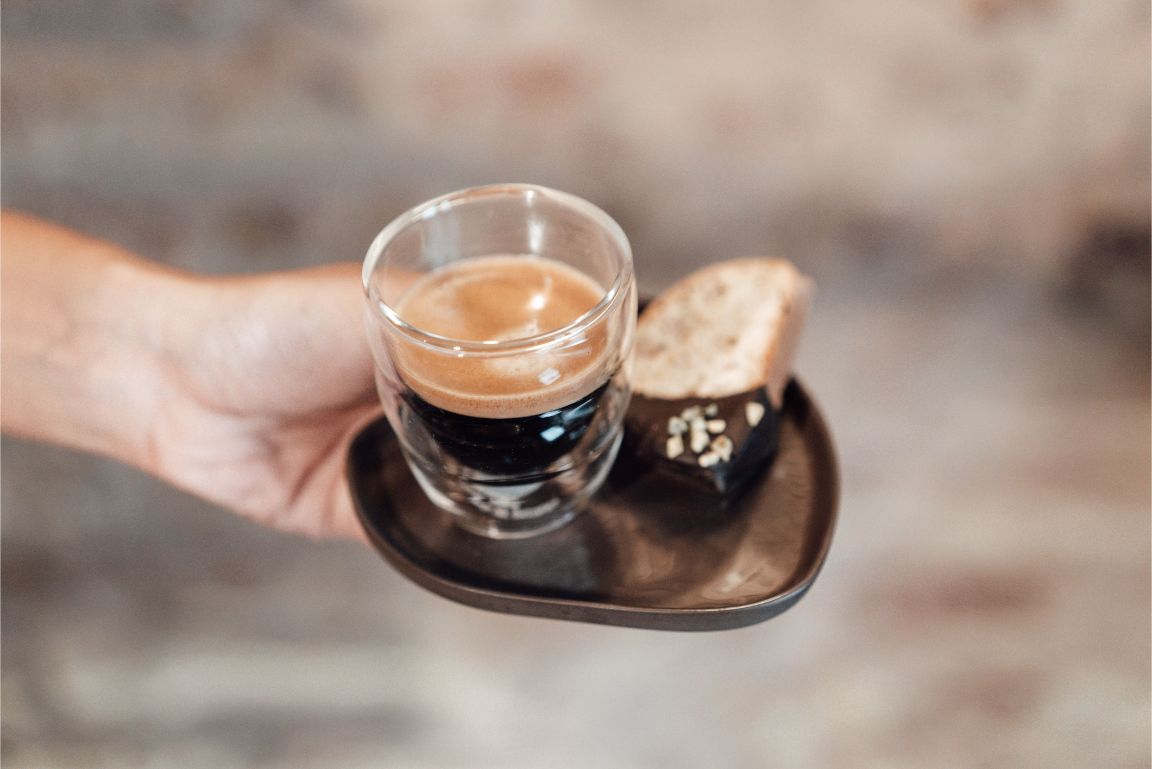
A ristretto is a short, concentrated espresso made with the normal amount of ground coffee but a smaller amount of liquid in the cup.
Where a modern espresso commonly starts around a 1:2 brew ratio, a ristretto often falls between approximately 1:1 and 1:1.5. That means an 18-gram dose might produce roughly 18–27 grams of finished coffee rather than around 36 grams. Breville describes a traditional ristretto as a 1:1 shot, while Specialty Coffee Association material also uses a beverage ratio around 1:1.5 when discussing ristretto-style extraction.
The result is smaller, denser, and more concentrated than a regular espresso.
It may taste sweeter, heavier, or less bitter because the extraction stops before as much of the later portion reaches the cup. That is a common tendency, not a guarantee. The bean, roast, grinder, water, temperature, and puck preparation still determine whether the shot tastes balanced.
Ristretto recipe box
| Setting | Starting point |
|---|---|
| Coffee dose | 18 grams |
| Beverage yield | 18–27 grams |
| Brew ratio | 1:1 to 1:1.5 |
| Grind | Fine; begin near your espresso setting |
| Water temperature | Around 200°F / 93°C |
| Pressure | Use your machine’s normal espresso setting |
| Shot time | Use taste and yield rather than chasing one fixed time |
| Cup | Preheated espresso cup or demitasse |
| Expected result | A small, concentrated shot with substantial body and a short finish |
The Specialty Coffee Association’s survey of contemporary espresso preparation found a common standard espresso starting point of 18–20 grams of coffee, roughly 36.5 grams of beverage, and a 25–30-second extraction. A ristretto reduces the beverage yield relative to that espresso baseline.
What does “ristretto” mean?
“Ristretto” is an Italian word meaning restricted, narrowed, or shortened.
The name refers to restricting the amount of beverage produced from the espresso puck. Instead of allowing the shot to continue to a normal espresso yield, the extraction is stopped earlier.
Breville describes it as a “short shot,” while Nespresso uses 25 milliliters as its classic capsule-system ristretto size, compared with 40 milliliters for espresso and 110 milliliters for lungo. Those capsule volumes are useful examples but are not universal recipes for portafilter machines.
For a home espresso setup, measuring the shot by weight is more useful than relying on milliliters. Crema occupies volume without weighing much, so two visually similar shots can contain different amounts of liquid.
How is a ristretto made?
A ristretto uses the same basic equipment and brewing process as espresso:
- Finely ground coffee is placed in an espresso basket.
- The coffee is distributed and tamped.
- Hot water is forced through the coffee under pressure.
- The extraction is stopped at a smaller beverage yield.
The most useful distinction is the ratio.
For example:
| Drink | Coffee dose | Beverage yield | Ratio |
|---|---|---|---|
| Ristretto | 18 g | 18 g | 1:1 |
| Longer ristretto | 18 g | 27 g | 1:1.5 |
| Espresso | 18 g | 36 g | 1:2 |
| Lungo | 18 g | 54 g or more | 1:3 or longer |
These are practical starting points rather than official worldwide definitions. Coffee shops and machine manufacturers do not all use identical recipes.
Does a ristretto use less coffee?
Usually, no.
A ristretto normally uses the same dry coffee dose that would be used for espresso. What changes is the finished beverage yield.
For example:
Espresso: 18 grams in → 36 grams out
Ristretto: 18 grams in → 18–27 grams out
Because the same amount of ground coffee produces less liquid, the drink is more concentrated.
This is different from simply using a smaller basket or reducing the coffee dose. A seven-gram single shot and an 18-gram double ristretto are both short drinks, but they are not the same recipe.
What does a ristretto taste like?
A well-made ristretto usually has:
- concentrated flavor
- substantial body
- a dense mouthfeel
- a shorter finish
- less beverage volume
- pronounced sweetness when the coffee is well suited
- less of the dry or bitter character sometimes found near the end of a longer extraction
Breville describes ristretto as more intense and full-bodied than a regular espresso because it is extracted with less water.
However, “more intense” does not mean automatically better.
A ristretto can taste:
- sharply sour when too little extraction occurs
- salty when severely underextracted
- heavy but undeveloped
- overly roasty with some dark beans
- hollow when the grind and ratio do not work together
Stopping a poorly dialed espresso early does not turn it into a balanced ristretto.
The recipe still needs to suit the coffee.
Is ristretto sweeter than espresso?
It can taste sweeter, but not every ristretto will.
During espresso extraction, different compounds enter the cup at different rates. The earliest liquid is highly concentrated, while later portions change the drink’s balance and reduce its overall concentration.
By stopping at a lower yield, a ristretto excludes more of the later extraction. Depending on the coffee, this may emphasize sweetness, acidity, aroma, and body while limiting some drying or bitter characteristics.
The important phrase is depending on the coffee.
A light roast that needs a longer ratio to develop properly may taste sour and incomplete as a very short ristretto. A medium roast designed for espresso may become rich and sweet at a shorter yield.
Taste the result rather than assuming that a 1:1 number must be correct.
Is ristretto stronger than espresso?
It is usually stronger in concentration and perceived intensity.
The same amount of coffee is packed into a smaller beverage, so every sip can feel denser and more powerful.
But “stronger” can also mean:
- more caffeine
- darker roasted
- more bitter
- made with more coffee
- more concentrated
- heavier in body
A ristretto is not automatically stronger in every sense.
It normally uses the same coffee dose as espresso, has less liquid, and is more concentrated. It may be less bitter rather than more bitter.
Does ristretto contain more caffeine?
Not necessarily.
A ristretto often contains slightly less total caffeine than a longer espresso made from the same dose because less water passes through the grounds. However, much of coffee’s caffeine and soluble material is extracted early in an espresso shot. One time-resolved espresso study found that major amounts of caffeine, organic acids, and solids entered the cup during the first eight seconds of percolation.
That means a ristretto does not contain half the caffeine simply because it produces approximately half the liquid.
The practical takeaway is:
- Ristretto is more concentrated.
- Total caffeine may be somewhat lower.
- The difference is unlikely to match the difference in serving volume.
- Dose and coffee variety can matter more than whether the shot is called ristretto or espresso.
Do not choose ristretto as a reliable caffeine-reduction method.
Is a ristretto more bitter?
A properly made ristretto is often perceived as less bitter than a longer shot because the extraction ends earlier.
De’Longhi describes ristretto as its shortest and most intense espresso serving, while Breville characterizes it as concentrated and full-bodied rather than simply more bitter.
Still, a ristretto can taste bitter when:
- the coffee is roasted very dark
- the machine temperature is too high
- the basket contains stale residue
- the shot channels
- the grind is so fine that the flow nearly stops
- the coffee itself has strong roast bitterness
- the dose is too high for the basket
A short beverage yield does not protect the shot from every brewing problem.
How to make a ristretto at home
This method is designed for a semi-automatic espresso machine, an espresso-capable grinder, a scale, and a non-pressurized basket.
Step 1: Warm the machine and cup
Allow the espresso machine to reach its proper operating temperature.
Warm the portafilter and cup according to the machine’s normal routine. A cold portafilter or cup can remove heat from the small ristretto serving quickly.
De’Longhi recommends serving ristretto in a preheated espresso cup.
Step 2: Choose a familiar coffee
Begin with coffee you already understand as espresso.
A medium or medium-light roast is often easier than an extremely dark coffee because the shortened yield may emphasize roast bitterness in some darker beans. Breville specifically suggests considering a lighter roast to avoid excessive bitterness in ristretto preparation.
You do not need special “ristretto beans.”
The label on the bag matters less than whether the coffee tastes good at a shorter ratio.
Step 3: Use your normal espresso dose
Use a dose that fits your basket properly.
For this recipe:
18 grams of ground coffeeKeeping the dose the same as your normal espresso makes the ratio easier to compare.
Do not overfill the basket to make the drink “stronger.” An overloaded basket can contact the shower screen, interfere with water distribution, and make the result less consistent.
Step 4: Start near your espresso grind setting
Use the setting that already produces a reasonable espresso, then make small adjustments based on the ristretto’s flow and taste.
Some traditional approaches use a finer grind to create additional resistance. Other approaches use the normal espresso grind and simply stop the shot earlier.
Neither method is automatically correct for every coffee.
A practical approach is:
- Begin at the normal espresso setting.
- Pull the ristretto by weight.
- Taste it.
- Grind slightly finer only when the shot reaches the target too quickly and tastes thin or undeveloped.
For grinder fundamentals, see our Coffee Grind Size Chart.
Step 5: Distribute and tamp carefully
Distribute the grounds evenly before tamping.
The smaller yield can make uneven extraction particularly noticeable. When one side of the puck flows faster, the cup may contain a combination of sharp, weak, and harsh flavors.
Tamp level and clear loose coffee from the basket rim.
You do not need to tamp harder than usual. Consistency and level preparation matter more than maximum force.
Step 6: Place the cup on a scale
Tare the scale with the cup beneath the portafilter.
Do not judge the yield only by cup height or crema.
For an 18-gram dose, choose an initial target:
18 grams in → 27 grams outA 1:1.5 ratio is a practical first ristretto because it is short without being as demanding as a strict 1:1 shot.
Step 7: Start the extraction
Begin the shot and watch both the scale and flow.
The espresso should develop into a controlled stream rather than:
- spraying
- running pale immediately
- dripping one drop at a time for an extended period
- flowing heavily from only one side
Breville’s visual ristretto guidance describes a finished flow resembling warm honey and gives approximately 15–20 milliliters as one traditional result.
Use that as a visual cue, but let the scale and taste guide your actual recipe.
Step 8: Stop at the target weight
Stop the pump shortly before the scale reaches the target because a small amount of liquid may continue dripping afterward.
For the first attempt:
Stop near 25–26 grams
Final yield: approximately 27 grams
Machines differ in how quickly the flow stops, so learn how much post-pump dripping your setup produces.
Step 9: Stir and taste
Gently stir the ristretto before tasting.
The earliest and latest liquid in the cup may have different concentrations. Stirring combines them into a more representative drink.
Let it cool for a moment, then assess:
- sweetness
- acidity
- bitterness
- body
- finish
- whether the center of the flavor feels developed
Do not judge only by crema thickness.
How to tell whether your ristretto worked
A successful ristretto should have:
- a controlled extraction
- substantial body
- intense but recognizable flavor
- no obvious salty taste
- no aggressive sourness
- no harsh drying finish
- enough sweetness or balance to drink without dilution
- a finish that remains pleasant as it cools
The result should taste concentrated, not merely unfinished.
When the ristretto tastes sour
A sour ristretto may be underextracted.
Try one adjustment:
- grind slightly finer
- increase the yield from 1:1 to 1:1.5
- increase the water temperature slightly when the machine allows
- improve puck distribution
- allow the machine to heat fully
- try a coffee that is easier to extract
For example, change:
18 grams in → 18 grams outto:
18 grams in → 24 or 27 grams outThe drink will still be shorter than a standard espresso but may taste more developed.
When the ristretto tastes bitter or dry
Try:
- reducing the water temperature slightly
- grinding a little coarser
- checking for channeling
- using a lighter roast
- reducing the dose when the basket is overfilled
- cleaning the basket and shower screen
- stopping at a slightly smaller yield
Do not assume that making the shot even shorter will always remove bitterness. Roast character and uneven flow can remain bitter from the beginning.
When the shot runs too quickly
A ristretto that reaches 27 grams almost immediately may taste thin or sharply acidic.
Try:
- grinding finer
- checking the coffee dose
- improving distribution
- using fresher beans
- confirming that the basket matches the dose
Change the grinder in small steps. Espresso can shift from fast to nearly blocked with a relatively modest adjustment.
When the shot barely flows
Do not allow the pump to struggle against an almost completely blocked puck for an extended period.
Try:
- grinding coarser
- reducing the dose slightly
- checking whether the basket is overdosed
- tamping normally rather than excessively
- cleaning the basket holes
- confirming that the coffee is not ground far beyond the machine’s practical range
A ristretto should be restricted, not stalled.
Should you stop a normal espresso early or change the grind?
Both methods are used.
Method 1: Stop the normal espresso early
This is the easiest way to explore ristretto.
Keep:
- the same beans
- the same dose
- the same grinder setting
- the same puck preparation
Change only the yield.
This clearly shows how the shorter ratio affects the coffee, but the result may taste underextracted with some beans.
Method 2: Dial in specifically for ristretto
Adjust the grinder and possibly temperature until the shorter yield tastes balanced.
This takes more work but treats ristretto as its own recipe rather than half of an existing espresso.
Start with Method 1. Move to Method 2 when you like the general character but want more sweetness or balance.
Which brew ratio should you use?
Use the ratio that tastes balanced.
1:1 ratio
18 grams in → 18 grams outThis produces an extremely short, dense drink.
It may work well with coffee that extracts easily, but it can taste undeveloped with some lighter beans.
1:1.5 ratio
18 grams in → 27 grams outThis is a practical starting point for home users.
It remains distinctly shorter than a normal espresso while allowing additional extraction.
Between 1:1.5 and 1:2
18 grams in → 30–33 grams outSome coffees taste best here.
The result may still be described as a short espresso even when it is not a strict traditional ristretto.
Labels are less important than a balanced cup.
Ristretto, espresso, and lungo
| Drink | Typical ratio | General character |
|---|---|---|
| Ristretto | Around 1:1 to 1:1.5 | Short, dense and concentrated |
| Espresso | Around 1:2 | Balanced concentration and extraction |
| Lungo | Around 1:3 or longer | Larger, lighter and more extended |
The Specialty Coffee Association’s contemporary espresso survey found approximately 1:2 to be a common espresso recipe, while its water-and-extraction discussion places ristretto around a much shorter beverage ratio.
The difference is not merely cup size. Passing more or less water through the puck changes both concentration and extraction.
Is ristretto good with milk?
Yes.
Ristretto can work especially well in smaller milk drinks because its concentrated flavor and body remain noticeable after milk is added.
It may suit:
- cortado
- piccolo latte
- flat white
- small cappuccino
- macchiato
A large latte may need two ristretto shots because one short beverage can become lost in a large quantity of milk.
A ristretto-based milk drink may taste rounder or sweeter than one made with a longer espresso, but the result depends on the coffee and milk ratio.
Can you make ristretto with a pressurized basket?
Yes, but adjustment is more limited.
A pressurized basket creates additional resistance through the basket design, so the grinder setting has less direct control over the flow than it does with a standard non-pressurized basket.
To make a ristretto with one:
- Use the machine’s normal recommended dose.
- Start the shot.
- Stop at a shorter volume or weight.
- Taste before changing other variables.
- Adjust the beverage setting when the machine allows it.
This can make a convenient short coffee, although it may not offer the same dialing-in control as a non-pressurized setup.
Can an automatic espresso machine make ristretto?
Many bean-to-cup machines include a ristretto option or allow the beverage volume to be programmed.
Check whether the machine changes:
- coffee dose
- grinder setting
- beverage volume
- aroma or strength setting
- number of grinding cycles
A machine that simply reduces the water volume can still produce a ristretto-style drink. Adjust the coffee-strength setting when the result tastes too weak.
Do not assume that “extra strong” and “ristretto” mean the same thing. Extra strong may increase the coffee dose, while ristretto usually refers to reducing the beverage yield.
How does a capsule ristretto differ?
Capsule systems usually define ristretto through a preset beverage volume.
Nespresso Original, for example, commonly presents ristretto as 25 milliliters, espresso as 40 milliliters, and lungo as 110 milliliters.
A capsule designed for ristretto may also use:
- a roast intended for short extraction
- a particular grind size
- a coffee blend chosen for intensity
- a dose formulated for the preset volume
Use the recommended capsule size first. Running a lungo capsule at ristretto volume or a ristretto capsule at lungo volume may produce a result the blend was not designed for.
Which coffee beans work best?
There is no single correct ristretto roast.
Medium roast
Often a useful starting point because it can provide:
- sweetness
- moderate acidity
- chocolate or nut notes
- manageable extraction
- enough intensity for milk
Medium-light roast
May produce:
- brighter acidity
- fruit or floral notes
- greater aroma
- a lighter finish
It may require a slightly longer ristretto ratio to avoid tasting underdeveloped.
Dark roast
May create:
- pronounced roast flavor
- heavy body
- low perceived acidity
- strong bitterness
- smoky or charred notes
A very dark roast may become overwhelming at a concentrated 1:1 ratio.
For more help choosing coffee, read Espresso Beans vs Coffee Beans.
Common ristretto misunderstandings
“Ristretto uses fewer grounds”
It normally uses the same dose as espresso but produces less liquid.
“Ristretto is simply a 15-second espresso”
Time alone does not define the drink.
Dose and beverage yield give you a clearer recipe. An arbitrary 15-second shot can be balanced, sour, or nearly blocked depending on the grinder and machine.
“Ristretto always uses exactly a 1:1 ratio”
A 1:1 ratio is common, but many practical ristretto recipes extend toward 1:1.5.
“Ristretto has much less caffeine”
It may contain somewhat less, but substantial caffeine extraction occurs early. The difference is not reliably proportional to the smaller cup.
“Ristretto is always sweeter”
Some ristrettos emphasize sweetness, while others taste sour, salty, or roast-heavy.
“Ristretto is a different coffee bean”
It is a brewing recipe, not a separate species or required roast.
“The thickest crema means the best ristretto”
Crema is influenced by freshness, bean variety, roast, pressure, and other variables. Judge the drink by flavor rather than foam volume alone.
When should you choose ristretto?
Ristretto is worth trying when:
- normal espresso tastes too bitter or dry
- you prefer dense, short drinks
- you enjoy small milk beverages
- you want to explore how brew ratio changes flavor
- your coffee tastes sweet and developed at a lower yield
- you want a concentrated drink without increasing the dose
A normal espresso may suit you better when:
- ristretto repeatedly tastes sour
- you prefer a more open flavor profile
- you drink larger milk beverages
- your coffee needs more water to extract properly
- you want an easier recipe to repeat
Neither drink is more advanced or more authentic in every situation.
Frequently asked questions
Is ristretto the same as espresso?
It is a type of espresso preparation, but it uses a smaller beverage yield and a shorter brew ratio than a regular espresso.
How many grams should a ristretto be?
For an 18-gram coffee dose, begin around 18–27 grams in the cup. Adjust based on taste.
Is ristretto stronger than espresso?
It is more concentrated and may taste more intense, but it does not necessarily contain more caffeine.
Is ristretto less bitter?
It often can be, because the extraction ends sooner. Roast level, temperature, grind, and puck preparation can still produce bitterness.
How long should a ristretto take?
There is no universal time. Traditional guidance sometimes uses approximately 15–20 seconds, but modern preparation is better controlled through dose, yield, flow, and taste.
Should I grind finer for ristretto?
Possibly. Begin near your normal espresso setting. Grind slightly finer when the shot reaches the target too quickly and tastes undeveloped.
Can I make ristretto without a grinder?
You can use pre-ground espresso coffee with a pressurized basket or compatible capsule machine, but you will have less control over the flow.
Is ristretto good for lattes?
It works well in small milk drinks. A large latte may need two shots to maintain enough coffee flavor.
Does ristretto use less water?
Yes. Less brewed water passes through the coffee, producing a smaller beverage.
What cup should I use?
Use a small preheated espresso cup or demitasse so the short serving does not cool immediately.
The takeaway
A ristretto is a short espresso made by restricting the beverage yield rather than reducing the coffee dose.
Start with 18 grams of coffee and aim for approximately 18–27 grams in the cup. A 1:1.5 ratio is a practical beginner target because it creates a concentrated drink while allowing more extraction than an extremely short 1:1 shot.
Measure by weight, taste the result, and adjust one variable at a time.
The goal is not to produce the smallest possible espresso. It is to find a short ratio that makes your coffee taste concentrated, sweet, and complete.